








What's Happening?
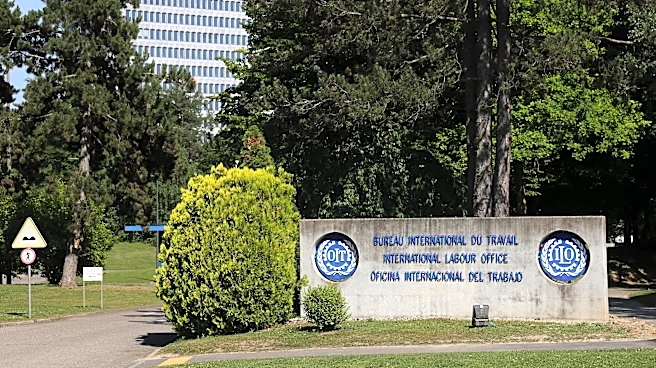
The International Labour Organization (ILO) recently hosted a global conference in Geneva, emphasizing the urgent need for renewed action on universal social protection. The event, titled 'Universal Social Protection in a Changing World: Advancing Social Development
and Decent Work,' brought together governments, workers' and employers' organizations, international institutions, and civil society representatives. Participants stressed that translating political commitments and national strategies into reality is crucial for achieving universal social protection. The conference, organized by the ILO, the World Bank, and the Friedrich-Ebert-Stiftung under the Global Partnership for Universal Social Protection (USP2030), focused on strengthening political commitment, national policies, and an enabling global environment for social protection. Discussions highlighted the necessity of a comprehensive approach that supports pathways from cash transfers to decent and productive employment with social security. According to the ILO's World Social Protection Report 2024–26, only 52.4% of the world's population is covered by at least one social protection benefit, leaving 3.8 billion people unprotected.
Why It's Important?
The call for universal social protection is critical in a rapidly changing global context marked by climate change, demographic shifts, technological transformation, and widening inequalities. These factors increase the demand for robust social protection systems, while growing debt burdens, constrained public budgets, conflicts, and declining development assistance limit countries' capacity to invest in them. Strengthening social protection is vital for reducing income inequality, as demonstrated by historical examples in Scandinavian countries where social protection and progressive taxation led to significant income compression. Experts at the conference, such as Lucas Chancel of the World Inequality Lab and Jayati Ghosh of the University of Massachusetts Amherst, underscored the macroeconomic benefits and growth potential of social protection, arguing that these aspects are often underestimated. Effective social protection systems can provide a safety net, promote economic stability, and foster inclusive growth, particularly for vulnerable populations.
What's Next?
The conference concluded with a strong call for coherent national policies, sustained investment, robust institutions, and enhanced international cooperation to transform political commitments into effective access to comprehensive and sustainable social protection systems. Future efforts will likely focus on implementing strategies that extend social security to those in the informal economy and facilitate transitions to formality. This includes developing simple registration processes, flexible contribution schemes, and publicly financed support for workers unable to afford regular payments. Stakeholders will also need to adapt social protection to individuals' changing needs throughout their lives and careers, ensuring it remains relevant amidst evolving labor markets. The ongoing collaboration under the USP2030 partnership will continue to advocate for and support national and global initiatives aimed at achieving universal social protection, with an emphasis on leaving no one behind.
Beyond the Headlines
The push for universal social protection extends beyond immediate economic benefits, touching upon fundamental issues of social justice and human rights. The ILO's mandate to promote internationally recognized human and labor rights underpins this initiative, aiming to ensure that all individuals have access to basic social security. The ethical dimension of social protection highlights a collective responsibility to protect the most vulnerable members of society, fostering greater equity and reducing societal disparities. Legally, the implementation of universal social protection requires robust national frameworks and international agreements to ensure enforceability and sustainability. Culturally, it signifies a shift towards societies that prioritize collective well-being and solidarity, recognizing that a secure populace is essential for overall societal stability and progress. This long-term vision aims to build resilient societies capable of withstanding future economic shocks and social challenges.