





What's Happening?
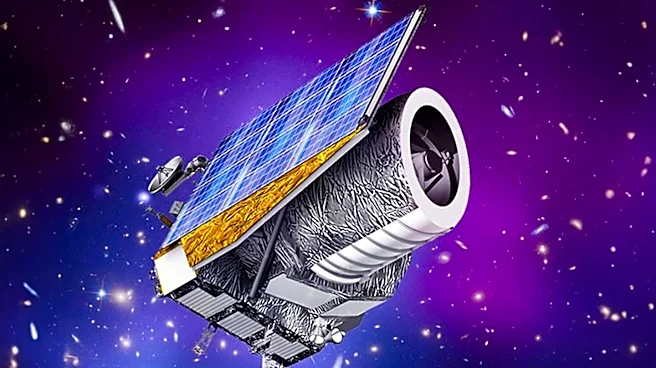
An international team of astronomers has discovered 31 quasars, including the two oldest ever observed, using the European Space Agency's Euclid telescope. These quasars, powered by supermassive black holes, are among the brightest objects in the universe
and provide insights into the early universe's infancy. The light from the oldest quasars dates back to when the universe was approximately 670 million years old, just 5% of its current age. This discovery surpasses the previous record for the oldest quasar by about 20 million years. The Euclid telescope, launched in 2023, has significantly advanced the field by doubling the number of known ancient quasars in just two years.
Why It's Important?
The discovery of these ancient quasars is crucial for understanding the early universe, particularly the epoch of reionization when the first stars and galaxies formed. Quasars act as lighthouses, allowing scientists to study the gas between them and Earth, thus tracing the universe's reionization history. The findings challenge existing theories about the size and formation speed of early cosmic objects, as these quasars are far larger than previously thought possible at such an early stage. This raises questions about how these massive structures formed so quickly, prompting further investigation into the universe's early development.
What's Next?
The research team plans to continue searching for even older quasars to better understand the universe's early history. The James Webb Space Telescope has also observed these newly discovered quasars, and the team will soon analyze the data collected. The ultimate goal is to create a comprehensive 'quasar chronicle' of the universe's first billion years, which could provide significant insights into the formation and evolution of early cosmic structures.