
What's Happening?
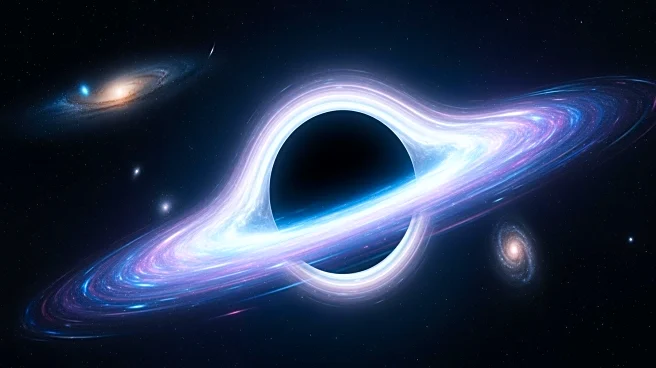
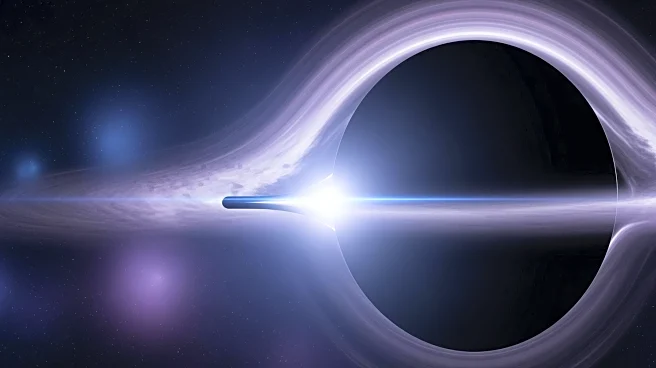
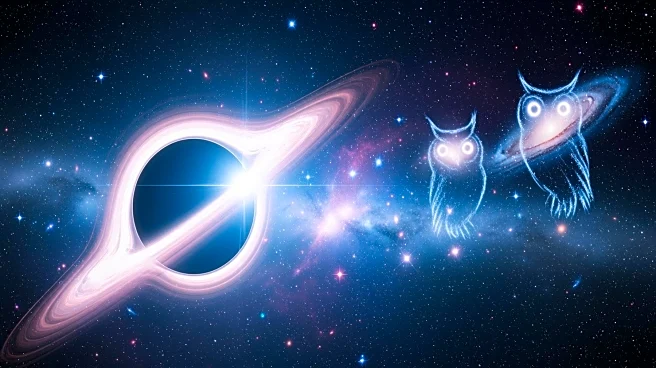
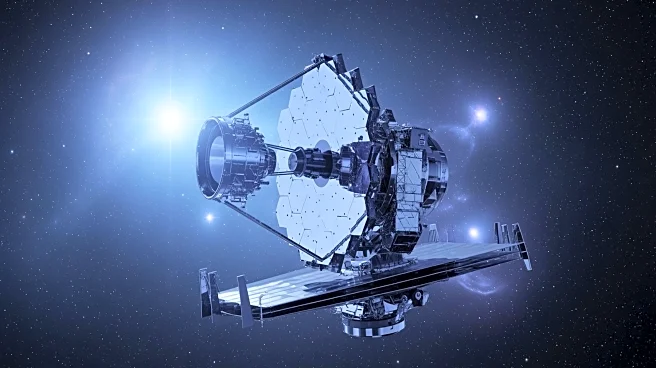
Astronomers using the James Webb Space Telescope (JWST) have confirmed the existence of a runaway supermassive black hole, which is 10 million times the mass of the sun, traveling at an extraordinary speed of 2.2 million miles per hour. This black hole is moving
through a pair of galaxies known as the 'Cosmic Owl,' creating a massive 'bow-shock' of matter and leaving a 200,000 light-year-long tail in its wake. The discovery was initially made using the Hubble Space Telescope, which detected the wake of the black hole. The JWST has now confirmed the presence of the black hole at the tip of this wake, providing clear evidence of its high velocity and the shock wave it generates in the surrounding gas.
Why It's Important?
This discovery is significant as it confirms theoretical predictions about runaway supermassive black holes, which were previously unobserved. The findings highlight the dynamic nature of galaxies and the potential for such black holes to impact their environments significantly. The runaway black hole's interaction with surrounding gas can lead to new star formation, demonstrating a previously unknown mode of star creation. This discovery also opens new avenues for research, as astronomers can now search for similar phenomena using space-based imaging, potentially leading to a better understanding of galaxy dynamics and black hole behavior.
What's Next?
The research team plans to search for more runaway black holes using upcoming space telescopes like the Roman Space Telescope and Euclid. These telescopes will provide wide-field, high-quality imaging that can help identify the thin streaks indicative of runaway black holes. Additionally, machine learning algorithms may be employed to analyze data and detect these phenomena more efficiently. The continued study of runaway black holes could provide further insights into galaxy mergers and the frequency of such events, enhancing our understanding of cosmic evolution.
Beyond the Headlines
The discovery of a runaway supermassive black hole challenges existing models of galaxy formation and evolution. It suggests that galaxy mergers, which can lead to the ejection of black holes, may be more common than previously thought. This has implications for our understanding of the distribution of black holes in the universe and their role in shaping galaxies. Furthermore, the ability of these black holes to trigger star formation in their wake could influence the development of new galaxies, adding a new dimension to the study of cosmic structures.