






What's Happening?
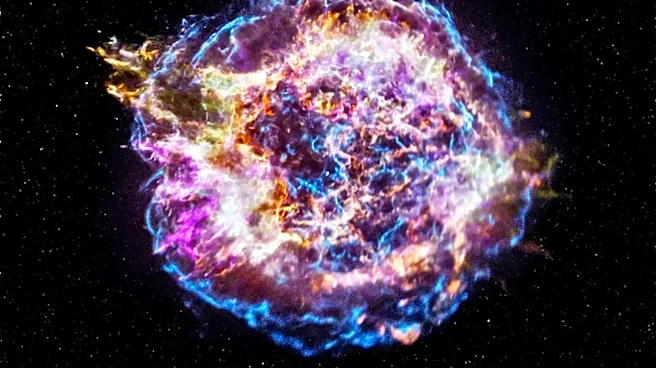
Astronomers have made the most detailed observations to date of Pa 30, a unique celestial relic from a supernova explosion witnessed approximately 850 years ago. This 'string of pearls' supernova remnant, the only one of its kind observed in the Milky
Way, features dandelion-shaped chains of gas and supernova debris. What makes Pa 30 particularly unique is the presence of a rare 'zombie star' at its heart. Supernovas like the one that formed Pa 30 are classified as Type Ia, occurring when a white dwarf star accretes matter from a companion star, leading to a runaway nuclear explosion. In rare instances, this explosion doesn't completely destroy the white dwarf, leaving behind a shattered stellar body known as a zombie star, characteristic of Type Iax supernovas. Pa 30 was initially identified by a citizen scientist in 2013 and later linked to historical records of a cosmic explosion in 1181 from Japanese, Chinese, and Arabic documentation, making it one of only five supernovas observed before the invention of the telescope. Using the Gemini North telescope, researchers, including Ilaria Caiazzo from the Institute of Science and Technology Austria (ISTA), discovered knots along the gas strands radiating from the explosion site, each large enough to encompass Neptune's orbit ten times over. The zombie star is found almost perfectly at the center of Pa 30, suggesting a surprisingly symmetrical explosion with a minimal 'kick' to the remnant star.
Why It's Important?
The detailed study of Pa 30 and its central 'zombie star' offers an unprecedented opportunity to understand Type Iax supernovas, a rare class of stellar explosions. This research is crucial for refining our models of stellar evolution and supernova dynamics, particularly for events where a white dwarf survives a nuclear explosion. The proximity of Pa 30, approximately 7,500 light-years from Earth, makes it an ideal 'laboratory' for such studies, allowing for observations with exceptional detail that are not possible for more distant phenomena. Understanding the uniform nature of the 'pearls' or knots within the remnant and the near-stationary position of the zombie star provides critical data points for theoretical models of supernova ejecta and the forces at play during these cosmic events. The insights gained from Pa 30 could help astronomers identify other Type Iax supernova remnants in our galaxy and beyond, expanding our knowledge of these unusual stellar deaths and their impact on galactic chemical enrichment and star formation.
What's Next?
Scientists plan to further model the formation of the remarkably uniform knots within Pa 30 to better understand the processes that shaped the supernova remnant. The distinctive properties of Pa 30, particularly the presence and characteristics of its zombie star, will be used as a template to search for remnants of other Type Iax supernovas in the Milky Way and neighboring galaxies. This ongoing research aims to unravel the remaining mysteries surrounding Pa 30 and its unique occupant, potentially leading to a more complete census of these rare stellar events. Future observations with advanced telescopes and continued analysis of the collected data are expected to provide further clues into the mechanics of Type Iax supernovas and the long-term evolution of their remnants. The findings, published in The Astrophysical Journal, will serve as a foundation for subsequent investigations into these cosmic phenomena.
Beyond the Headlines
The study of Pa 30 transcends immediate astronomical findings by connecting modern scientific observation with ancient historical records. The fact that this supernova was documented by Japanese, Chinese, and Arabic astronomers in 1181 highlights the long-standing human fascination with celestial events and the continuity of scientific inquiry across millennia. This interdisciplinary link underscores the value of historical data in contemporary scientific research, providing a unique temporal baseline for understanding cosmic phenomena. Furthermore, the concept of a 'zombie star' — a star that survives an explosion that should have destroyed it — challenges conventional understandings of stellar death and resilience. This phenomenon pushes the boundaries of astrophysical theory, suggesting that the universe may harbor more unexpected outcomes than previously imagined. The ongoing efforts to model and understand Pa 30 could lead to a re-evaluation of fundamental principles governing stellar explosions and the life cycles of stars, potentially revealing new physics or refining existing theories about the extreme conditions in the cosmos.