



What's Happening?
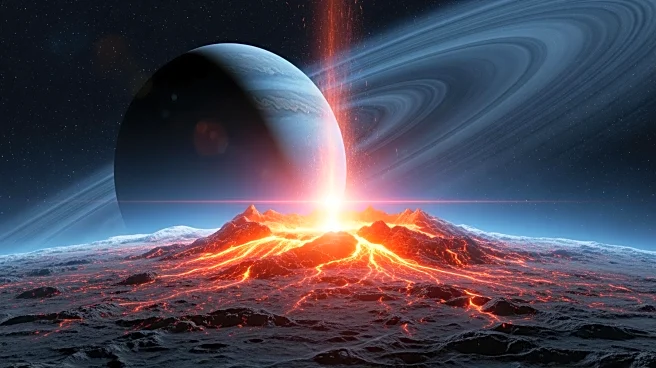
NASA's Juno spacecraft has captured the largest volcanic eruption ever observed on Jupiter's moon Io. The event occurred on December 27, 2024, during one of Juno's close fly-bys, when the spacecraft was 46,200 miles above Io's surface. The eruption covered
an area of 40,400 square miles and involved multiple active sources, suggesting a network of interconnected magma reservoirs beneath Io's surface. The energy released was estimated between 140 and 260 terawatts, surpassing previous records. Io, known for its volcanic activity, has approximately 400 active volcanoes driven by gravitational tidal forces from Jupiter.
Why It's Important?
This discovery highlights the dynamic geological activity on Io, providing insights into the moon's subsurface structure and volcanic processes. The simultaneous eruptions suggest interconnected magma reservoirs, which could reshape understanding of Io's geology. The findings may influence future missions and research on volcanic activity in the solar system. Understanding Io's volcanic behavior is crucial for planetary science, as it offers a natural laboratory for studying extreme geological phenomena, potentially informing theories about Earth's own volcanic processes.
What's Next?
Juno's extended mission includes further fly-bys of Io to monitor changes in its surface, such as new lava flows and ash deposits. These observations will help scientists understand the aftermath of the eruption and the moon's geological evolution. Continued study of Io's volcanic activity may lead to discoveries about the moon's internal structure and the forces driving its eruptions. Future missions could focus on exploring Io's subsurface and the potential for interconnected magma systems.
Beyond the Headlines
The eruption on Io raises questions about the moon's internal dynamics and the role of gravitational forces in shaping its geological features. The interconnected magma reservoirs suggest a complex subsurface environment, potentially similar to porous structures found on Earth. This event may prompt discussions on the implications for planetary formation and the influence of tidal forces on celestial bodies. The findings could also inspire new models for understanding volcanic activity across the solar system.