






What's Happening?
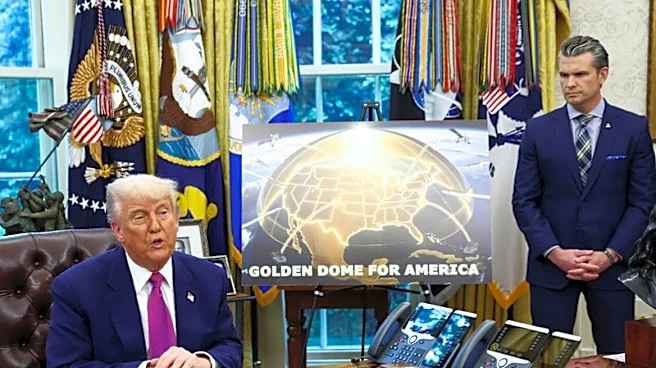
President Trump’s ambitious 'Golden Dome' missile defense initiative, designed to protect the United States from next-generation strategic weapons, is projected to cost $1.2 trillion over 20 years, according to a Congressional Budget Office (CBO) analysis.
This figure significantly exceeds the initial $175 billion estimate provided by Trump. The system, inspired by Israel's 'Iron Dome', aims to incorporate both ground and space-based capabilities to detect and intercept missiles at various stages of an attack. The CBO report highlights the lack of detailed plans from the Defense Department, making precise cost estimations challenging. Despite the high cost, Congress has already allocated $24 billion for the project through a tax and spending measure. General Michael A. Guetlein, director of the Golden Dome project, emphasized the focus on affordability, countering claims that the project is a financial boon for defense contractors.
Why It's Important?
The 'Golden Dome' project represents a significant investment in national defense, reflecting heightened concerns over advanced missile threats from global adversaries. The substantial cost projection underscores the financial burden on U.S. taxpayers and raises questions about the allocation of defense spending. Critics, including Senator Jeff Merkley, argue that the project benefits defense contractors at the expense of working Americans. The initiative's success or failure could influence future defense strategies and budget priorities, impacting the U.S. military's ability to respond to evolving threats. The project's financial implications also highlight the broader debate over military spending versus other domestic priorities.
What's Next?
As the 'Golden Dome' project progresses, further scrutiny from lawmakers and defense analysts is expected. The CBO's report may prompt calls for more detailed planning and transparency from the Defense Department to justify the project's costs. Potential adjustments to the project's scope or funding could arise as Congress evaluates its long-term viability and strategic value. The initiative's development will likely continue to be a focal point in discussions about national security and fiscal responsibility, influencing future defense policy decisions.