






What's Happening?
Researchers from the University of Illinois Urbana-Champaign, in collaboration with the Technical University of Denmark, have successfully developed and tested the first three-dimensional thermal invisibility cloak. This innovative device can conceal
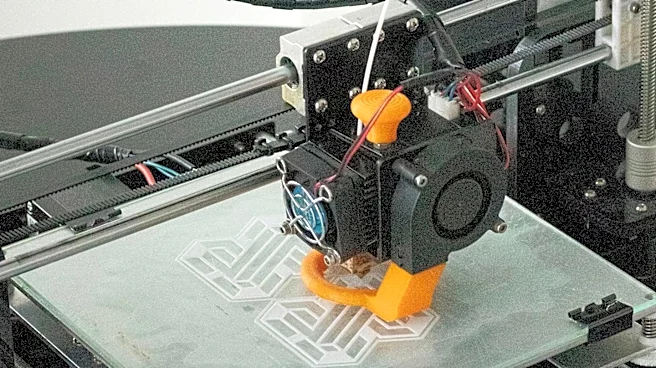
objects from infrared cameras while simultaneously protecting them from extreme temperatures. Unlike previous thermal cloaks that were limited to two dimensions or specific heat flow directions, this new design effectively redirects heat around a hidden object, making it appear absent to infrared imaging. The team achieved this breakthrough by creating a novel lattice-based material with adjustable thermal properties in three dimensions, allowing for precise control over heat conduction. The working prototype, constructed using 3D metal printing for efficient heat pathways and a rubber-like material for poor heat conduction, demonstrated its ability to guide heat around complex 3D objects, including shapes resembling human heads, while maintaining stable internal temperatures.
Why It's Important?
This development holds significant implications across various U.S. industries and national security. In electronics, the technology could revolutionize thermal management in microchips and sensitive components, enhancing their performance and longevity under demanding conditions. For security and defense, future iterations of this cloak could provide advanced stealth capabilities, allowing for the concealment of personnel or equipment from thermal detection systems. This could offer a strategic advantage in military operations and intelligence gathering. Furthermore, the ability to shield valuable assets from severe temperature fluctuations has broad applications, from industrial processes to space exploration. The research represents a fundamental step in controlling heat flow, potentially leading to new methods for protecting information carried by heat, which could impact data security and privacy in thermal imaging contexts.
What's Next?
The researchers are now focused on developing more sophisticated versions of the thermal cloak capable of concealing objects that generate their own heat, rather than just protecting against external heat sources. This next phase will require materials that can actively control, concentrate, distribute, or guide thermal energy dynamically. Such advancements would significantly expand the technology's utility in areas like advanced electronics, where heat dissipation is a critical challenge, and in more complex thermal protection scenarios. The team aims to create cloaks that not only hide and protect but also actively manipulate heat in beneficial ways, opening doors for new applications in infrared detection and thermal engineering. Continued funding from organizations like the National Science Foundation and the Air Force Office of Scientific Research will be crucial for these future developments.
Beyond the Headlines
Beyond its immediate practical applications, this thermal invisibility cloak touches upon deeper scientific and philosophical questions regarding perception and concealment. The ability to manipulate a fundamental physical property like heat to render objects undetectable to specific sensors challenges conventional notions of visibility. Ethically, the development of such advanced stealth technology raises considerations about its potential dual-use nature, requiring careful deliberation on its deployment and oversight to prevent misuse. Culturally, it could influence science fiction and popular imagination, much like optical invisibility has. Long-term, this research could pave the way for entirely new fields of material science focused on dynamic control of energy, potentially leading to innovations far beyond thermal cloaking, impacting areas from energy efficiency to advanced medical diagnostics.