






What's Happening?
A study led by Hai-Bo Yu, a physicist at the University of California, Riverside, suggests that self-interacting dark matter (SIDM) could provide explanations for three astrophysical puzzles. Published in Physical Review Letters, the research indicates
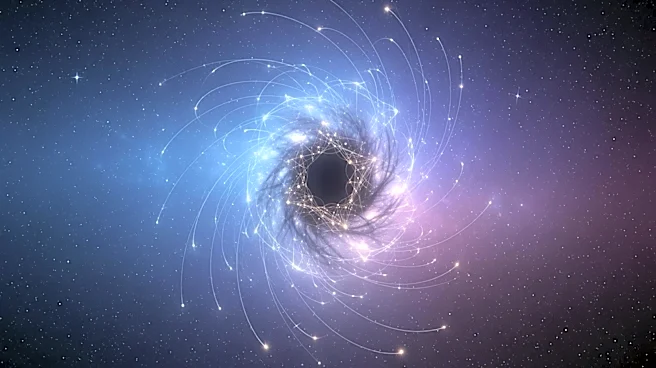
that dense clumps of SIDM, each about a million times the mass of the sun, can account for unusual gravitational effects observed in various cosmic phenomena. These include gravitational lenses, stellar streams, and satellite galaxies. Unlike the standard model of dark matter, which assumes particles are 'cold' and collisionless, SIDM involves particles that collide and exchange energy, potentially leading to 'gravothermal collapse' and the formation of dense cores.
Why It's Important?
The study's findings could significantly impact our understanding of dark matter, which constitutes about 85% of the universe's matter. The standard model has struggled to explain certain high-density structures observed in the universe. By proposing SIDM, Yu's research offers a potential solution to these discrepancies, suggesting that dark matter interactions can reshape the internal structure of dark matter halos. This could lead to a paradigm shift in astrophysics, influencing how scientists model the universe's structure and evolution. The implications extend to various fields, including cosmology and particle physics, as they seek to understand the fundamental nature of dark matter.
What's Next?
Further research and observations are needed to validate the SIDM model. Scientists may focus on identifying more cosmic phenomena that could be explained by SIDM, as well as developing new technologies to detect these interactions. Collaboration between observational astronomers and theoretical physicists will be crucial in testing the predictions of the SIDM model. If confirmed, this could lead to new insights into the formation and behavior of galaxies and other cosmic structures.
Beyond the Headlines
The concept of SIDM challenges the traditional view of dark matter and could lead to new theoretical frameworks in physics. It raises questions about the nature of particle interactions and the forces governing them. Additionally, understanding SIDM could have implications for the search for dark matter particles in laboratory settings, potentially guiding future experiments in particle physics.