

What's Happening?
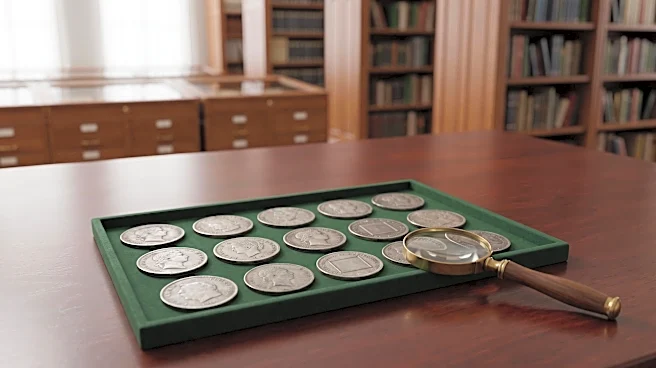
The Smithsonian Institution's National Numismatic Collection has provided crucial physical evidence linking its 1964 Kennedy Half Dollar specimen set to commercially known 'Adams-Merkin' sets. This connection suggests a single, specific origin for these
unusual strikes. Numismatic researchers, including Steve Roach and Jeff Garrett, have previously documented other 'off-the-books' presentation specimens held by the Smithsonian. The physical characteristics, such as distinct fabric and shared die flaws, observed in coins linked to former Mint Director Eva Adams and dealer Lester Merkin, are identical to those in the Smithsonian's specimen example. This evidence strongly indicates that these coins were struck from the exact same dies in close succession. The Mint's swift action to redesign the half dollar following President Kennedy's assassination involved Chief Engraver Gilroy Roberts adapting his 1961 Kennedy Presidential Medal portrait and Assistant Engraver Frank Gasparro adapting the Presidential Seal for the reverse. Early trial strikes were presented to Jacqueline Kennedy on December 17, 1963, leading to revisions in her late husband's hair detail on subsequent dies.
Why It's Important?
This revelation is significant for the numismatic community as it challenges long-held theories regarding the origin and classification of the 1964 'SMS' (Special Mint Set) coins. The matching physical features between the Smithsonian's set and the 'Adams-Merkin' sets provide definitive proof of a shared production origin, dispelling the notion that these were experimental prototypes for the 1965–1967 Special Mint Sets. This clarification helps to accurately document the history of U.S. coinage and provides a more precise understanding of the Mint's practices during a period of significant change, including the transition from silver to clad coinage. For collectors and historians, this information refines the provenance and authenticity of these rare coins, potentially impacting their market value and historical interpretation. The detailed forensic analysis of the coins themselves, even in the absence of extensive official documentation, underscores the importance of physical evidence in numismatic research.
What's Next?
The new understanding of the 1964 Kennedy Half Dollar specimen strikes is expected to continue to influence discussions within the numismatic community. While the theory of 'SMS experimental strikes' is largely being put to rest, debates may persist regarding whether these pieces should be classified as true Specimen strikes or simply early business strikes that received VIP handling. Numismatic researchers and collectors will likely further analyze the implications of this shared origin for other 'off-the-books' presentation specimens in the Smithsonian's collection. The detailed analysis of these coins, as highlighted by numismatic researcher Alex Schultz's work, will likely encourage further forensic examination of other historical coinage to uncover additional insights into Mint production processes and historical context. This ongoing research will contribute to a more accurate and comprehensive understanding of U.S. numismatic history.
Beyond the Headlines
The story of the 1964 Kennedy Half Dollar specimen strikes extends beyond mere numismatic classification, touching upon the intersection of historical events, government processes, and the meticulous work of preserving national heritage. The rapid redesign of the half dollar after President Kennedy's assassination reflects a moment of national mourning and the government's swift response to public sentiment. The involvement of Jacqueline Kennedy in the design process highlights the personal and emotional dimensions of this historical artifact. Furthermore, the existence of 'off-the-books' presentation specimens underscores the informal practices that sometimes accompanied official government operations, offering a glimpse into the human element behind institutional procedures. This narrative also emphasizes the enduring value of physical artifacts in corroborating or challenging historical records, demonstrating how tangible objects can speak volumes about their past, even when official documentation is sparse. The ongoing efforts to clarify these historical details contribute to a richer understanding of American history and the cultural significance of its coinage.