





What's Happening?
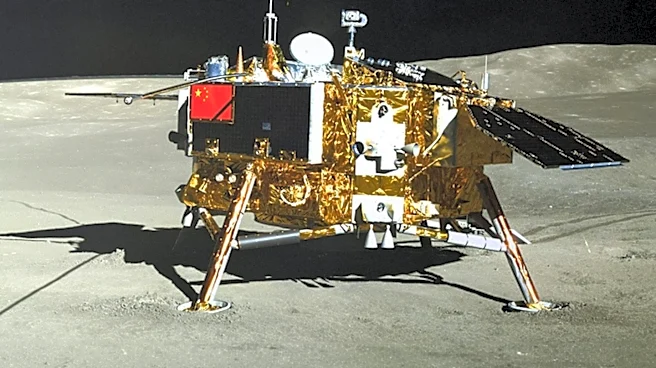
Researchers at Nanjing University in China have proposed a new explanation for the significant difference in appearance between the Moon's near side and far side. The study, published in the journal National Science Review, utilized rock samples collected
from the Moon's far side by China's Chang'e-6 mission in June 2024. The near side of the Moon is characterized by extensive dark plains formed by ancient lava, covering about a third of its surface, while the far side has a thicker crust and very few such plains, covering only about one percent. By comparing far-side basalts with near-side samples from Apollo and Chang'e-5 missions, the team found chemical similarities in the mantle beneath both sides but noted that the far-side crust contained more magnesium.
Why It's Important?
This research is important because it offers a new scientific hypothesis to explain a long-standing lunar mystery: why the two faces of the Moon are so different. Understanding the Moon's geological evolution provides crucial insights into the formation and early history of planetary bodies, including Earth. The data from the Chang'e-6 mission, which brought back the first-ever samples from the far side, is invaluable for lunar science. This new theory, based on the chemical composition of these unique samples, could refine our models of lunar differentiation and the processes that shaped the Moon's crust. It also highlights the growing contributions of international space agencies to planetary science.
What's Next?
The Nanjing University team's theory suggests that after the Moon became tidally locked with Earth, the two sides of its ancient magma ocean had different temperatures. This temperature difference drove slow sideways currents, transporting lighter crustal rock towards the far side and residual melted rock towards the near side. While this study adds significant evidence from the far side itself, it is presented as a possible answer rather than a definitive one. Future research will likely involve further analysis of the Chang'e-6 samples, as well as data from other lunar missions, to test and refine this hypothesis. Scientists will also continue to explore other proposed causes, such as giant impacts or Earth's gravitational heating, to build a comprehensive understanding of lunar asymmetry.
Beyond the Headlines
The Moon's asymmetrical appearance has long fascinated scientists and the public alike, often leading to cultural interpretations such as the 'man in the Moon' or the 'rabbit pounding rice cakes.' This scientific endeavor to explain such a fundamental characteristic of our closest celestial neighbor reflects humanity's enduring quest for knowledge about the cosmos. The new theory not only advances lunar geology but also underscores the complex interplay of physical forces that govern planetary evolution. It highlights how seemingly minor initial conditions, like temperature differences in a magma ocean, can lead to profound and lasting geological distinctions. This research also emphasizes the collaborative and competitive nature of space exploration, with multiple nations contributing to our understanding of the universe.