
What's Happening?
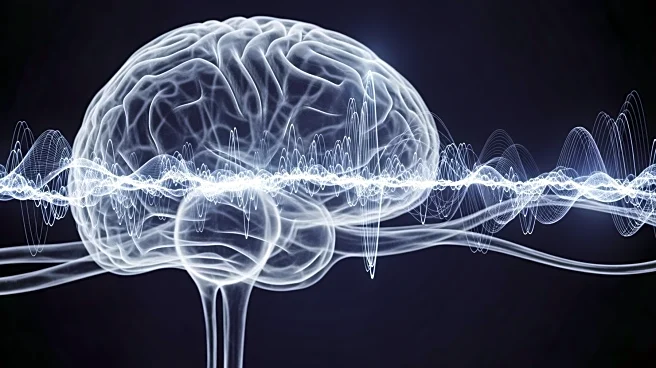
Recent research suggests that consciousness may arise from the brain's ability to resonate with the zero-point field (ZPF), a concept from quantum electrodynamics. The study, published in Frontiers in Human
Neuroscience, proposes that the brain's cortical microcolumns couple directly to the ZPF, leading to synchronized brain activity characteristic of conscious states. This interaction is believed to maintain the brain's critical dynamics, essential for conscious perception. The research opens new avenues for empirical testing, aiming to explore whether consciousness depends on resonant brain-ZPF interaction.
Why It's Important?
The findings challenge traditional views that consciousness is solely a product of electrochemical signaling, suggesting instead a quantum-based orchestration. This perspective could revolutionize neuroscience by integrating foundational physics into the understanding of consciousness. If proven, it may offer insights into long-standing metaphysical questions and potentially lead to new approaches in treating disorders related to consciousness. The study also highlights the brain's ability to maintain quantum coherence, which could have implications for understanding brain function under various states of consciousness.
What's Next?
Future research will focus on testing the model's predictions through systematic manipulations of cerebral cortex conditions. These experiments could validate the brain's harnessing of the ZPF and its role in consciousness. Success in these endeavors may pave the way for new therapeutic strategies targeting consciousness-related disorders and enhance our understanding of the brain's quantum dynamics.
Beyond the Headlines
The study suggests a paradigm shift in neuroscience, where consciousness is viewed as a product of quantum interactions rather than mere neural activity. This could lead to ethical and philosophical discussions about the nature of consciousness and its implications for artificial intelligence and machine learning, potentially influencing future technological developments.