



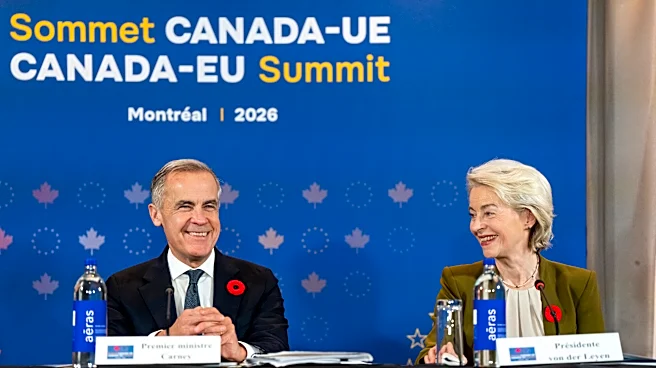

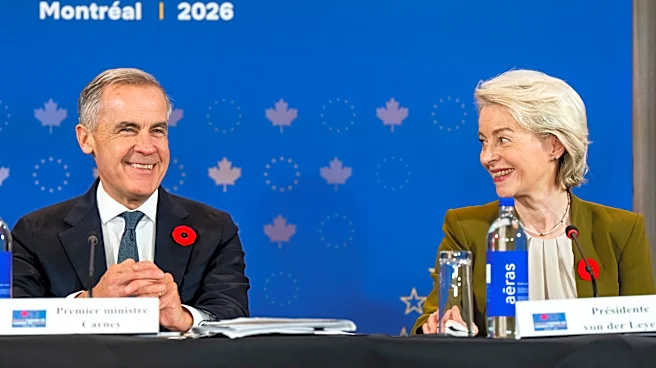

What's Happening?
Canada and the European Union are advancing towards an enhanced partnership, focusing on political, economic, and defense cooperation, despite the exclusion of 'associate membership' from their joint statement. The initial idea of granting Canada associate membership,
proposed by European Commission President Ursula von der Leyen, faced objections, including from Germany, due to the lack of a clear legal definition within the European institutional framework. Instead, the two parties have committed to developing a 'close and increasing association.' Key agreements include the completion of negotiations on a digital trade agreement, a second-generation cooperation agreement in competition, and a framework for European investments in Canadian strategic resources. They also agreed to accelerate their security and defense partnership, expanding cooperation in cybersecurity, critical infrastructure protection, maritime security, and countering hybrid threats. A working arrangement between the European Frontex agency and the Canadian Border Services Agency will also expand operational coordination in border protection.
Why It's Important?
This evolving partnership signifies a strategic alignment between Canada and the EU, aiming to strengthen their collective resilience and influence in a complex global environment. The digital trade agreement and investment framework for critical metals are particularly important for economic stakeholders, as they will facilitate cross-border data flows, enhance legal certainty for businesses, and secure supply chains for essential resources. The expanded security and defense cooperation, including cybersecurity and maritime security, addresses shared threats and reinforces the integration of their efforts with NATO. While the 'associate membership' concept was not adopted, the commitment to a 'close and increasing association' suggests a pragmatic approach to deepening ties without the complexities of formal EU membership. This could serve as a blueprint for other non-EU nations seeking closer collaboration with the bloc.
What's Next?
The next steps in this enhanced partnership include a meeting in March 2027 between the full European Commission and the Canadian federal government to define the content and scope of their future relationship. The goal is to finalize the concept of a 'close association' by the next Canada-European Union summit in 2027. The digital trade and competition agreements are expected to be implemented, fostering greater economic integration. The security and defense initiatives will see accelerated implementation, with increased operational coordination and information exchange. The working arrangement between Frontex and the Canadian Border Services Agency will also move forward, enhancing border protection efforts. These developments will be closely watched as Canada and the EU work to translate their political ambitions into a practical and sustainable cooperation model.
Beyond the Headlines
The decision to pursue an enhanced partnership without formal 'associate membership' reflects the intricate balance between political ambition and institutional realities within the EU. While the term 'associate member' might have offered a symbolic boost, the current framework allows for flexible and targeted cooperation across various sectors, potentially avoiding the legal and political hurdles associated with a new membership category. This approach could enable Canada to participate more deeply in European economic, technological, and security initiatives while maintaining its political independence. The emphasis on critical metals and secure supply chains also highlights a growing global concern over resource security and strategic autonomy, positioning Canada as a key partner for the EU in these areas. This partnership could influence future models of international cooperation, demonstrating how nations can forge strong alliances without necessarily pursuing full integration.