







What's Happening?
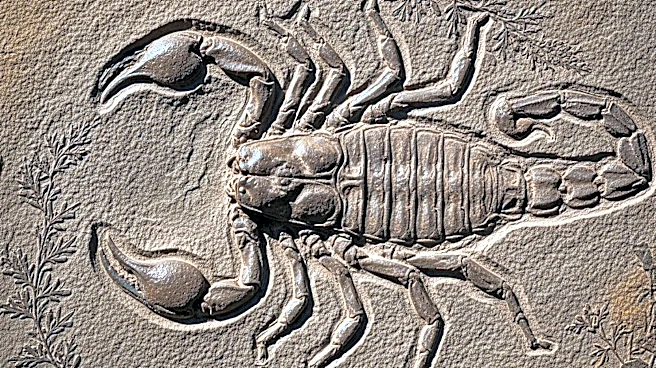
Fossils discovered in the U.K. have confirmed the existence of Praearcturus gigas, the largest scorpion ever known, measuring over a meter in length. This prehistoric scorpion lived during the Early Devonian Period, a time when life on land was just beginning
to evolve. The research, published in Palaeontology, resolves a long-standing debate about the identity of these fossils, previously thought to belong to a giant crustacean. The study highlights the scorpion's role as a dominant predator in its ecosystem, capable of hunting both on land and in water, due to its large size and formidable pincers.
Why It's Important?
The identification of Praearcturus gigas provides valuable insights into the early evolution of life on land, particularly the development of large predators in nascent ecosystems. This discovery challenges previous assumptions about the timeline of arthropod evolution and their adaptation to terrestrial environments. Understanding the ecological roles of such ancient species can inform current studies on biodiversity and evolutionary biology. Additionally, the research underscores the complexity of early life forms and their interactions, offering a glimpse into the dynamics of prehistoric ecosystems.