

What's Happening?
An international team of researchers has investigated the 2022 Hunga Tonga-Hunga Ha'apai eruption, focusing on how rapid caldera collapse can amplify tsunamis. Calderas form when the ground above a magma reservoir collapses as magma drains. Comparisons
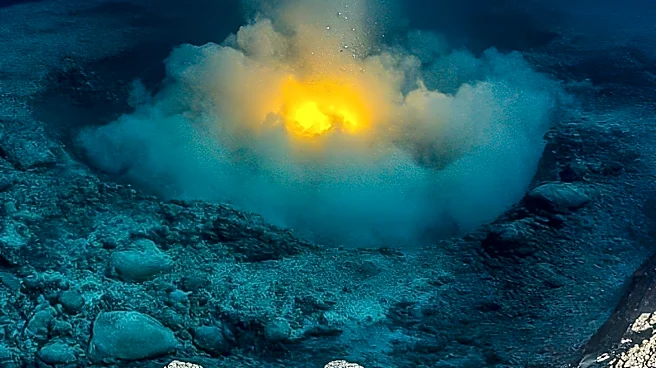
of seafloor topography before and after the Hunga eruption revealed that a roughly 4-kilometer-wide caldera sank by about a kilometer. The researchers suggest that this rapid collapse of the entire caldera likely enhanced the massive tsunami that followed. This indicates that even relatively small submarine calderas can generate dangerous waves under specific conditions, particularly depending on the speed and nature of their collapse. The Hunga eruption, which occurred on January 15, 2022, was one of the most powerful volcanic events of this century, with an eruption column soaring over 55 km and a pressure wave detected globally. The accompanying tsunami reached estimated heights of 40 meters within 100 km of the source, making it the highest tsunami ever recorded from an underwater volcanic eruption.
Why It's Important?
This research is crucial for understanding and mitigating tsunami risks, particularly for coastal communities in the U.S. and globally. The finding that even small undersea volcanoes can produce unusually large tsunamis challenges previous assumptions about volcanic tsunami generation. Many underwater calderas, especially in regions like the Tonga-Kermadec arc which hosts numerous similar structures, have not been thoroughly surveyed due to their inaccessibility. This lack of understanding means that potential threats from these geological features might be underestimated. Improved understanding of these dynamics is vital for enhancing early warning systems and disaster preparedness in coastal areas, as rapid caldera subsidence could trigger devastating waves with little warning. The U.S. Pacific coast, with its proximity to the Ring of Fire, could be particularly vulnerable to such events, necessitating updated risk assessments and emergency protocols.
What's Next?
The study highlights the need for more extensive surveying and mapping of underwater calderas, especially those in volcanically active regions like the Pacific Ring of Fire. Researchers will likely focus on developing better models to predict tsunami generation from caldera collapses, incorporating factors such as collapse speed and magnitude. This will involve utilizing advanced seafloor mapping technologies and seismic monitoring. Furthermore, the findings could prompt international collaborations to establish more robust monitoring networks for undersea volcanic activity. Coastal nations, including the U.S., may need to review and update their tsunami preparedness plans and public education campaigns to account for the newly identified risks posed by smaller, rapidly collapsing submarine calderas. The goal is to improve the accuracy of tsunami forecasts and provide communities with more lead time to evacuate and prepare.
Beyond the Headlines
The deeper implications of this research extend to the broader scientific understanding of geological hazards and their interaction with marine environments. The inaccessibility of many underwater calderas means that a significant portion of Earth's geological processes remains poorly understood. This study underscores the importance of investing in deep-sea exploration and technological advancements to gather critical data from these remote locations. Ethically, the findings place a greater responsibility on scientific communities and governments to communicate these complex risks effectively to the public, especially in vulnerable coastal regions. Culturally, a heightened awareness of these 'hidden' threats could influence how societies perceive and interact with their marine environments, potentially fostering a greater appreciation for the dynamic and sometimes dangerous forces at play beneath the ocean's surface. This could also drive innovation in marine robotics and autonomous underwater vehicles for hazard monitoring.