

What's Happening?
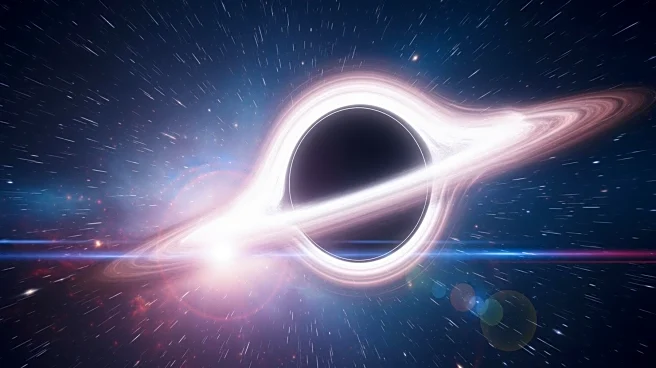
Astronomers have confirmed the existence of a runaway supermassive black hole (SMBH) using the James Webb Space Telescope (JWST). Located in the Cosmic Owl galaxy, approximately 8.8 billion light-years away, this SMBH is the first of its kind to be confirmed.
The runaway SMBH is believed to have been ejected from its host galaxy due to galaxy mergers, resulting in a long tail of stars and gas trailing behind it. The JWST's observations revealed a bow shock and a tail, key indicators of a runaway SMBH, providing strong evidence for its existence.
Why It's Important?
The confirmation of a runaway SMBH is a significant milestone in astrophysics, providing insights into the dynamics of galaxy mergers and the behavior of SMBHs. This discovery supports theoretical predictions about the ejection of SMBHs due to gravitational interactions during galaxy mergers. Understanding these processes is crucial for comprehending the evolution of galaxies and the role of SMBHs in shaping the universe. The findings also demonstrate the capabilities of the JWST in observing distant cosmic phenomena, highlighting its importance in advancing our knowledge of the universe.
What's Next?
Future research will focus on identifying additional runaway SMBHs and studying their impact on their surroundings. Upcoming telescopes, such as the Euclid and Roman Space Telescope, will play a key role in these efforts. Researchers will also explore the implications of runaway SMBHs for galaxy evolution and the distribution of matter in the universe. Continued observations and theoretical modeling will be essential in unraveling the complexities of these cosmic phenomena.