

What's Happening?
Comet 3I/ATLAS, the third confirmed interstellar object to pass through our solar system, is currently being studied by various space agencies. Following its closest approach to Earth on December 19, 2025, at a safe distance of 1.8 astronomical units,
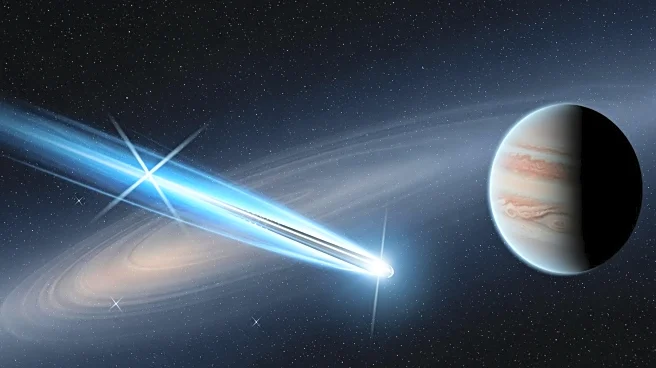
the comet has been the subject of extensive observation. NASA and ESA have reported that the comet exhibits an X-ray glow, a phenomenon caused by the interaction of its gases with the solar wind. This is a significant milestone as it is the first time such an observation has been made for an interstellar comet. The comet, discovered by the NASA-funded ATLAS survey telescope, is moving at high speeds and is expected to pass near Jupiter in March 2026.
Why It's Important?
The study of Comet 3I/ATLAS provides a unique opportunity to understand the chemistry and physics of interstellar objects. The X-ray observations offer insights into the comet's composition, particularly gases like hydrogen and nitrogen, which are difficult to detect through other means. This research contributes to our understanding of planetary formation in other star systems. Additionally, the comet's upcoming encounter with Jupiter will allow scientists to observe its behavior in a different gravitational environment, potentially offering further insights into its composition and trajectory.
What's Next?
The next significant event for Comet 3I/ATLAS will be its approach to Jupiter in March 2026. This encounter will be closely monitored by scientists, as Jupiter's gravity and magnetic field could influence the comet's trajectory and outgassing behavior. Observations from spacecraft near Jupiter, such as Juno, may provide additional data. The comet is expected to continue its journey out of the solar system, with its departure anticipated by the mid-2030s.
Beyond the Headlines
The study of Comet 3I/ATLAS is not only about scientific discovery but also about improving our readiness for future interstellar objects. The International Asteroid Warning Network is using this opportunity to enhance astrometric techniques, which are crucial for tracking fast-moving celestial bodies. This preparation is vital for potential future encounters with objects that could pose a threat to Earth.