

What's Happening?
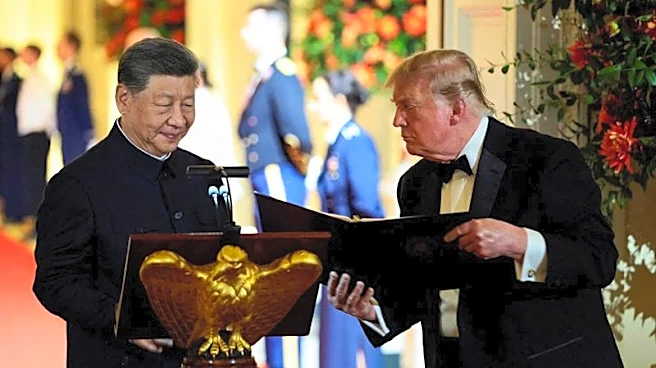
India is currently positioned as a significant 'middle power' within a 'bi-multipolar' global order, characterized by the dominance of two superpowers, the U.S. and China, alongside several influential middle powers. Experts suggest India's foreign policy
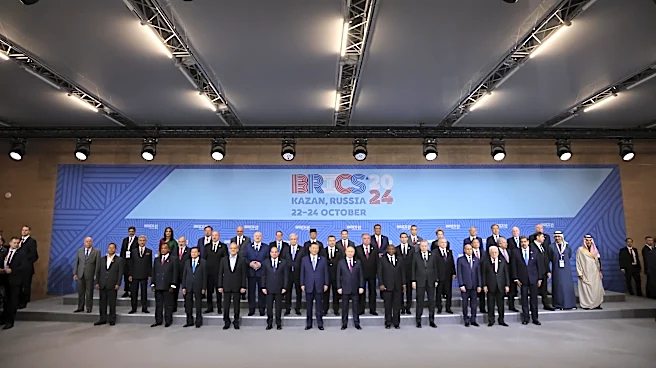
should be grounded in its economic reality, balancing ties between the U.S. and China while forging alliances with other mid-tier nations. Despite being the world's most populous country and among the fastest-growing major economies, India's per capita income remains low, and its economy and military strength are considerably smaller than those of the U.S. and China. India's foreign policy has evolved from non-alignment to multi-alignment, allowing it to partner with rival powers on different issues. This approach emphasizes strategic autonomy, enabling India to make independent choices without being bound to any single bloc. India actively engages in various groupings, including the Quad with the U.S., Japan, and Australia, and maintains long-standing partnerships with Russia on defense and energy.
Why It's Important?
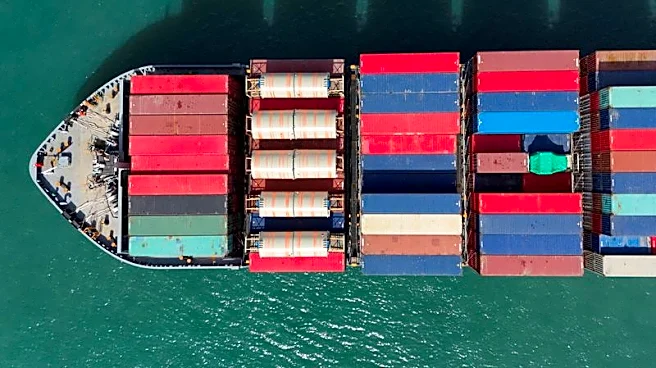
India's role as a middle power in a bi-multipolar world has significant implications for global stability and U.S. foreign policy. The U.S. views India as a crucial counterbalance to China, leading to strategic partnerships and collaborations. However, India's commitment to strategic autonomy means it will not exclusively align with either superpower, which can create complexities for U.S. diplomatic efforts. India's growing economic and military influence, coupled with its leadership in the Global South, positions it as a key player in shaping international norms and institutions. For U.S. businesses, India represents a vast and growing market, particularly as global companies seek to diversify supply chains away from China. India's efforts to build economic strength, advance technology, and secure its neighborhood will influence regional power dynamics and global trade flows. The challenges India faces, such as border tensions with China and dependence on defense imports, also present opportunities for U.S. engagement and cooperation.
What's Next?
India's future trajectory involves a continued focus on building economic strength, aiming for sustained high growth to achieve its 'Viksit Bharat 2047' vision. This includes expanding manufacturing through initiatives like PLI schemes and investing heavily in human capital. India is also committed to strengthening its defense capabilities through indigenization and investing in critical technologies such as semiconductors, AI, and quantum computing. Diplomatically, India will deepen its multi-alignment strategy, maintaining diverse partnerships while managing tensions with China. It will continue to build coalitions with other middle powers and advocate for reforms in global institutions like the UN Security Council. India's leadership in the Global South, representing developing countries on issues like climate finance and debt, is expected to grow. The U.S. will likely continue to court India as a strategic partner, navigating India's independent foreign policy choices and seeking areas of mutual interest, particularly in technology and defense.
Beyond the Headlines
Beyond the immediate geopolitical and economic considerations, India's rise as a middle power highlights broader themes of national identity, cultural influence, and the future of multilateralism. India's emphasis on 'strategic autonomy' reflects a desire to assert its own values and interests on the global stage, distinct from the Cold War-era non-alignment. The country's soft power, leveraging its culture, democracy, and diaspora, will play an increasingly important role in shaping global perceptions. The challenges of internal cohesion, regional imbalances, and human development within India will also influence its ability to project power externally. The ongoing debate about reforming global institutions to better reflect the current distribution of power will be significantly shaped by India's advocacy. Ultimately, India's journey from a middle power to a potential 'true pole' of the emerging world order will test the adaptability of existing international frameworks and redefine the nature of global leadership.