



What's Happening?
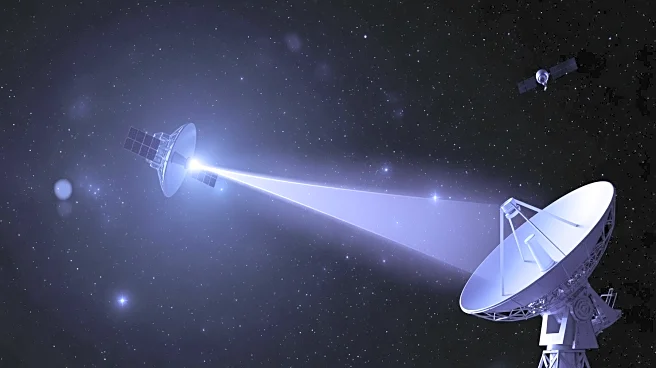
A Chinese satellite has successfully demonstrated a groundbreaking communication method by using a low-power laser to transmit data from 36,000 kilometers above Earth. This method, which operates on just 2 watts of power, challenges the current space
internet technologies like SpaceX's Starlink. The laser signal, despite atmospheric distortions, maintained high-speed data transmission, achieving a downlink speed of 1 gigabit per second. This efficiency is achieved through a technique developed by researchers from Peking University and the Chinese Academy of Sciences, which dynamically corrects distorted laser beams in real-time. The system's performance surpasses that of Starlink, which relies on a large network of low Earth orbit satellites.
Why It's Important?
This development signifies a potential shift in satellite internet strategies, offering a more efficient and less resource-intensive model compared to current systems. The use of fewer satellites at higher altitudes could reduce infrastructure costs and environmental impact. Additionally, the narrow and focused nature of laser beams enhances security, making them less susceptible to interception, which is crucial for military and scientific applications. This advancement could lead to more secure and reliable communication systems, especially in areas where traditional infrastructure is challenging to implement.
What's Next?
The success of this laser communication system could prompt further research and development in optical satellite technologies. Expanding the network of laser-compatible ground stations and improving all-weather reliability will be essential for scaling this technology. If these challenges are addressed, this approach could become a viable alternative to current satellite internet systems, particularly in regions requiring high-speed internet without extensive infrastructure.