



What's Happening?
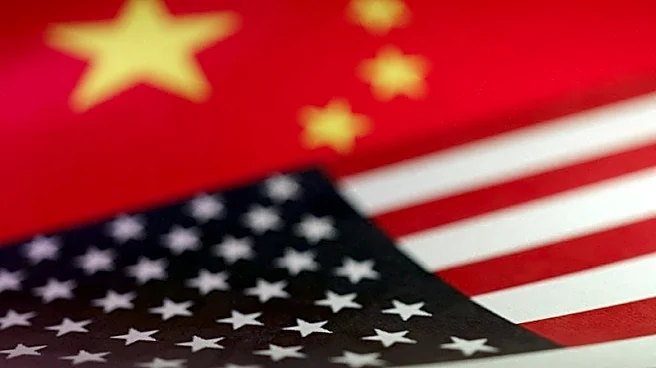
A new report from the Center for a New American Security (CNAS) indicates that the U.S. will struggle to assemble a unified global sanctions coalition if China alters the status quo in the Taiwan Strait. The report, based on interviews and research in Germany,
Singapore, and India, suggests that the U.S. must adopt partner-specific strategies rather than relying on a uniform approach. Germany, a close U.S. security partner with significant economic ties to China, would require tight alignment and joint planning on financial sanctions and technology controls. Singapore, a key financial and trade hub, is unlikely to impose its own sanctions due to its economic exposure and balancing act between the U.S. and China; instead, the U.S. should seek enforcement support. India, a major power with limited sanctions tools, could offer diplomatic influence and serve as an alternative manufacturing base. The report emphasizes that none of these countries would impose meaningful sanctions without clear U.S. leadership, highlighting the complex geopolitical and economic constraints each faces.
Why It's Important?
The findings underscore the significant challenges the U.S. faces in leveraging economic pressure as a deterrent against potential Chinese aggression toward Taiwan. China's deep economic integration with key global partners creates strong disincentives for countries like Germany, India, and Singapore to impose or escalate sanctions. This complicates U.S. foreign policy objectives and its ability to project unified international opposition. The report suggests that without tailored strategies and robust U.S. leadership, a sanctions coalition is far from assured, potentially weakening the effectiveness of economic deterrence. The reluctance of these nations to fully commit to sanctions could embolden China, impacting regional stability and global trade dynamics. The U.S. must rebuild trust with partners and clearly articulate an interests-based case for coordinated economic pressure to maximize the strategic benefits of sanctions tools.
What's Next?
The U.S. will need to refine its Taiwan policy and engage in early, partner-specific planning to build a viable sanctions coalition. For Germany, this involves pursuing tight alignment on financial sanctions and technology controls, with joint planning commencing now. With Singapore, the focus will likely be on securing quiet support for U.S. sanctions and cooperation on enforcement within its financial hub. For India, the U.S. should leverage its diplomatic influence and long-term economic potential, encouraging its role in rallying Global South support and serving as an alternative manufacturing base. The report suggests that signaling a coordinated approach between the U.S. and Europe on economic issues is one of the most powerful deterrent actions. The success of these efforts will depend on the U.S. demonstrating clear leadership and making a compelling case for coordinated economic pressure, especially given China's growing willingness to retaliate economically.
Beyond the Headlines
The CNAS report highlights a broader shift in global power dynamics, where economic interdependence with China increasingly complicates traditional alliance structures and U.S. foreign policy tools. The difficulty in forming a sanctions coalition reveals the limits of U.S. unilateral influence and the growing multipolarity of the international system. It also underscores the ethical and economic dilemmas faced by nations balancing their security interests with significant trade relationships. The report implicitly calls for a re-evaluation of U.S. diplomatic strategies, moving beyond broad appeals for solidarity to more nuanced, interest-driven engagements. This situation could lead to a long-term recalibration of global supply chains and economic partnerships as countries seek to de-risk from over-reliance on China, potentially fostering new economic blocs and trade routes. The implications extend to international law and the future of economic statecraft as a tool for geopolitical influence.