








What's Happening?
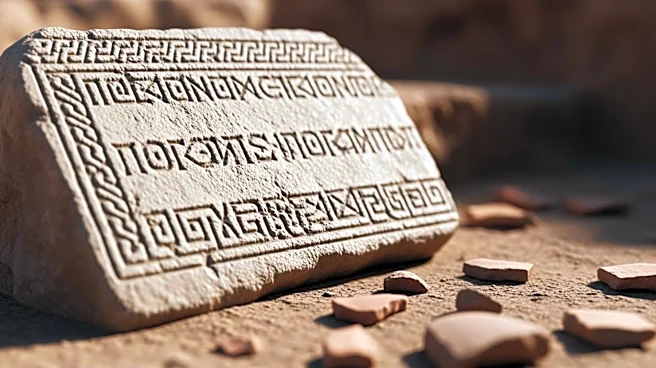
A newly discovered Greek inscription inside the Great Mosque of Homs in Syria is reigniting discussions about the ancient Temple of the Sun's location. This temple was historically linked to Elagabalus, a high priest who became a Roman emperor in the third
century AD. The inscription was found during restoration work at the mosque, which has a complex history involving multiple religious transformations. The site is believed to have been built over a church dedicated to St. John the Baptist, which may have replaced an earlier pagan temple. Dr. Maamoun Saleh Abdulkarim, a professor of archaeology and history, suggests that the inscription could provide crucial evidence about the site's origins, potentially linking it to the Temple of Elagabalus. The study highlights Emesa's religious evolution from paganism to Christianity and Islam, emphasizing the city's historical significance.
Why It's Important?
The discovery of the Greek inscription is significant as it may offer new insights into the religious and cultural history of Emesa, now Homs. Understanding the site's transformation from a pagan temple to a church and then a mosque could provide a clearer picture of religious continuity and adaptation in the region. This finding could also enhance interdisciplinary collaboration in archaeology, epigraphy, and heritage conservation. The research underscores the importance of Emesa as a historical and religious center, influencing regional politics, economy, and culture. The study of such transformations can reveal patterns of religious tolerance and coexistence, offering lessons for contemporary society.
What's Next?
Further analysis of the inscription is expected to clarify its connection to the Temple of Elagabalus. If confirmed, this could reshape historical narratives about the site's religious significance. The research may prompt additional archaeological investigations in the area, potentially uncovering more artifacts that could provide deeper insights into the region's past. Scholars and historians may engage in debates about the implications of these findings, influencing future studies on religious transformations in ancient cities.
Beyond the Headlines
The discovery highlights the broader theme of cultural continuity and adaptation in historical sites. Emesa's transformation reflects a negotiation between old beliefs and emerging faiths, reshaping not only religious buildings but also power dynamics and urban spaces. This pattern of adaptation rather than erasure of past traditions offers a model for understanding cultural resilience and integration. The study also emphasizes the role of religious sites in shaping a city's identity and their impact on social and political structures over time.