





What's Happening?
ABC has filed a lawsuit against the Federal Communications Commission (FCC), alleging that the agency's actions, specifically ordering early license renewals for its eight owned stations, constitute retaliation and a violation of the First Amendment.
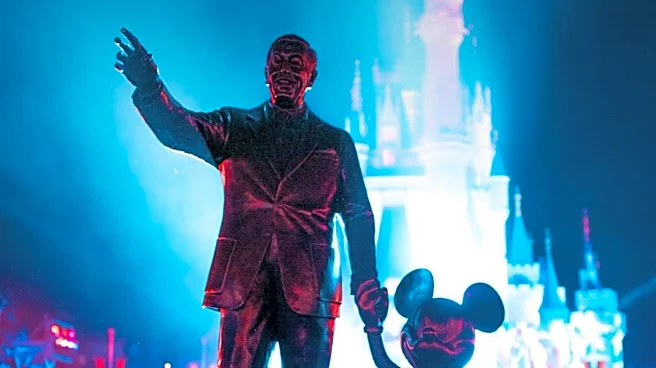
The network claims these actions are part of a campaign by the Trump administration to punish The Walt Disney Co. for its content, including programming featuring Jimmy Kimmel and 'The View.' The FCC's order for early license renewals, issued in late May, is described by ABC as highly unusual and a 'pretext' for a probe into the network's diversity, equity, and inclusion (DEI) practices. ABC's legal team argues that the FCC's actions are designed to suppress or punish disfavored expression, citing comments from FCC chairman Brendan Carr and President Trump's attacks on the network. Senator Ted Cruz (R-TX) is mentioned in the lawsuit for comments he made regarding the FCC's handling of a suspension of Jimmy Kimmel, which ABC uses to illustrate the perceived pressure from government officials.
Why It's Important?
This lawsuit represents a significant legal challenge to the FCC's authority and could have broad implications for free speech and media regulation in the U.S. If ABC succeeds, it could set a precedent limiting the government's ability to influence broadcast content through regulatory actions, potentially strengthening First Amendment protections for media organizations. Conversely, if the FCC prevails, it could affirm the agency's power to enforce public interest standards and conduct investigations, even if those actions are perceived as politically motivated. The case highlights the ongoing tension between government oversight and editorial independence, particularly in an era of heightened political polarization. The outcome could influence how broadcasters approach politically sensitive content and how regulatory bodies exercise their powers, affecting the landscape of American media and the balance between governmental authority and journalistic freedom.
What's Next?
A judge has scheduled a hearing for the week of October 5, with a briefing schedule set for September. The FCC plans to file a motion to dismiss the lawsuit, primarily on jurisdictional grounds, arguing that ABC should await the conclusion of the administrative review process and then seek recourse in the D.C. Circuit Court of Appeals, not a district court. ABC, however, contends that district courts are appropriate venues for First Amendment claims against agencies. The judge has indicated that if the FCC takes action on the licenses, such as designating renewals for an administrative hearing, the parties would be called to court the following day. This suggests that while the FCC can continue its investigations, there may be a disincentive to take definitive action on the licenses until after the October hearing. The initial phase of litigation will focus on whether the court will grant ABC a temporary restraining order to halt the FCC's early review.
Beyond the Headlines
The lawsuit delves into deeper implications concerning the weaponization of regulatory power and the chilling effect it can have on protected speech. ABC's claim that 'The View' has been bypassing political candidates as guests due to 'cumulative pressure from the FCC’s multiple actions' illustrates how perceived threats of regulatory action can lead to self-censorship and impact editorial decisions. This raises questions about the subtle ways in which government bodies can influence media content without direct censorship. The case also touches upon the interpretation of the 'public interest standard' for broadcasters and whether DEI investigations can be legitimately used as a basis for regulatory scrutiny, or if they can serve as a pretext for political retaliation. The outcome could redefine the boundaries of acceptable government interaction with the press and potentially influence future legal challenges regarding free speech and regulatory oversight.