





What's Happening?
The relationship between the United States and Mexico is characterized by deep interdependence, historical influences, and shared challenges, as highlighted by Natalia Saltalamacchia Ziccardi, a professor and chair of International Studies at the Instituto
Tecnologico Autónoma de Mexico. Saltalamacchia emphasizes that North American integration is a significant asset, fostering economic strength through interconnected supply chains that generate jobs and enhance competitiveness for both nations. This partnership is particularly crucial in the context of global transformations and increasing strategic competition, such as that between the U.S. and China. Mexico's government views a strong, productive partnership with the U.S. as a solution to many of America's challenges, aiming to deepen productive integration to strengthen North America's industrial capacity and build resilient supply chains. Historically, the relationship has been shaped by Mexico's territorial losses and U.S. interventions in the 19th and early 20th centuries, which instilled a strong commitment to non-intervention and national sovereignty in Mexican foreign policy. More recently, the shift towards an export-oriented economy and the North American Free Trade Agreement (NAFTA) transformed the perception of proximity to the U.S. from a vulnerability to a source of opportunity.
Why It's Important?
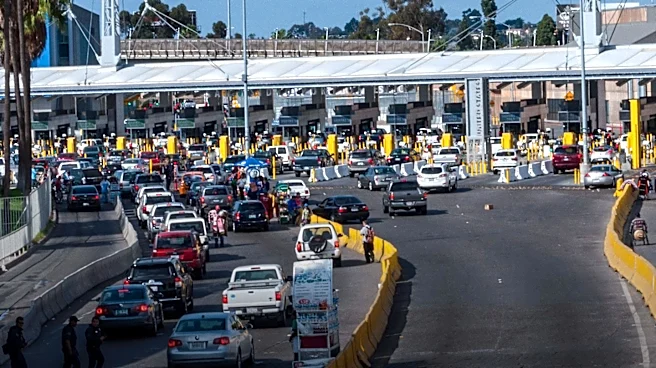
The U.S.-Mexico relationship is vital for both countries, impacting their economies, security, and social structures. Economically, the integrated supply chains and trade partnerships are crucial for regional competitiveness and job creation in both nations. This economic interdependence means that policies in one country often have direct consequences for the other. On the security front, both countries share the imperative to address issues like drug trafficking and border security, though their approaches may differ. Mexico advocates for a regional and multilateral approach to migration, emphasizing shared and differentiated responsibility, while the U.S. often focuses on border enforcement. Misconceptions persist on both sides: the U.S. often views Mexico primarily through the lens of violence and drugs, overlooking its diverse economy and rich culture, while Mexico sometimes equates the U.S. with its government or foreign policy, neglecting the diversity within American society. Understanding these nuances is critical for fostering mutual empathy and effective collaboration on shared challenges.
What's Next?
Moving forward, the U.S. and Mexico will continue to navigate their complex relationship, focusing on deepening economic integration while addressing areas of divergence. Mexico will likely continue to advocate for a regional and multilateral approach to migration, emphasizing root causes and international development cooperation over solely border enforcement. Discussions on trade will remain critical, with Mexico seeking to preserve the benefits of North American integration amidst U.S. emphasis on tariffs. Security cooperation will also be a key area, with both countries needing to find common ground on tackling drug trafficking and border security while respecting national sovereignty. Efforts to foster mutual empathy and understanding, as suggested by Saltalamacchia, will be crucial for building a stronger partnership. This includes recognizing each other's historical experiences, concerns, and diverse perspectives to find common ground and collaborate effectively on shared challenges.
Beyond the Headlines
The U.S.-Mexico relationship extends beyond economic and security concerns, touching upon profound cultural, social, and ethical dimensions. The historical legacy of territorial loss and intervention continues to influence Mexican identity and its foreign policy principles, particularly its strong adherence to non-intervention. This historical context is essential for understanding Mexico's perspective on issues like migration and sovereignty. The presence of vibrant border communities, such as Cali-Baja, exemplifies how local actors can forge cross-border networks to address shared challenges, demonstrating a bottom-up approach to binational cooperation. The call for mutual empathy highlights the need for both nations to move beyond stereotypes and engage in a deeper understanding of each other's societies, cultures, and internal complexities. This deeper understanding is not just about policy alignment but about building a foundation of respect that can sustain the relationship through periods of disagreement and foster a more equitable and productive partnership in the long term.