





What's Happening?
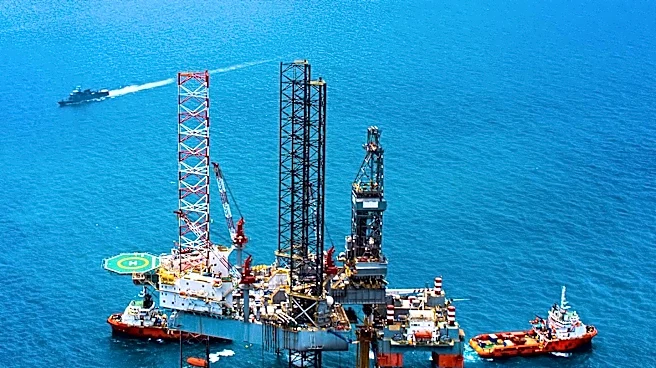
Researchers from the University of Mississippi and the University of Southern Mississippi have secured a $950,000 contract from the Bureau of Ocean Energy Management (now Marine Mineral Administration) to investigate the potential presence of critical
minerals, including lithium, in the Orca Basin. This deep-sea brine basin, located off the coast of Louisiana, is characterized by extremely salty water that forms distinct pools. The three-year project will involve water chemistry analysis, seafloor mapping, and deep-sea sampling to determine if and how valuable elements accumulate in these brine pools. University of Mississippi geologist Leo Macelloni, director of the Mississippi Mineral Resources Institute and Center for Marine Resources and Environmental Technology, emphasized the dual challenge of discovering these minerals and developing best practices for their stewardship to preserve marine life.
Why It's Important?
The discovery of extractable critical minerals in the Orca Basin could significantly bolster U.S. mineral supply chains and enhance national defense capabilities. Critical minerals are essential components in modern technology, ranging from cell phones and car batteries to data chips. Currently, the U.S. relies heavily on foreign sources for many of these materials. Identifying domestic reserves would reduce this dependency, mitigating supply chain vulnerabilities and geopolitical risks. Beyond commercial extraction, the research aims to deepen the understanding of how critical minerals are transported, redistributed, and concentrated in deep-ocean environments. This scientific insight is crucial for future resource management and environmental protection efforts, even if the concentrations prove too low for immediate commercial viability. The project also highlights the growing importance of marine geology in addressing national resource needs.
What's Next?
The research team, including Macelloni and USM professors Wokil Bam and Stephan Howden, plans a 15-day research expedition this year to collect water and brine samples from the Orca Basin. Their immediate goal is to characterize the area and assess the chemistry of the brine to confirm the presence of critical minerals. If significant concentrations are found, future projects would then focus on developing environmentally sound extraction methods. The project's success is not solely defined by commercial discovery but also by the valuable insights gained into deep-ocean mineral processes. This understanding will inform future exploration and policy decisions regarding marine mineral resources, potentially paving the way for sustainable resource development in the Gulf of Mexico and other deep-sea environments.
Beyond the Headlines
This research initiative underscores a broader national effort to secure critical mineral resources, driven by both economic and strategic imperatives. The delicate balance between resource extraction and environmental preservation in sensitive deep-sea ecosystems presents a significant challenge. The project's emphasis on understanding the environmental impact and developing best practices reflects a growing awareness of the need for responsible resource management. The potential for the Orca Basin to become a domestic source of critical minerals could also stimulate technological innovation in deep-sea mining and environmental monitoring. Furthermore, this research contributes to the U.S.'s long-term strategy for energy independence and technological leadership, reducing reliance on potentially unstable foreign supply chains and fostering domestic scientific expertise in marine resource exploration.