








What's Happening?
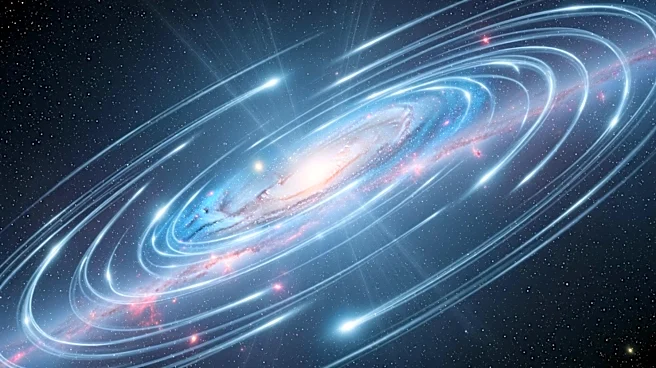
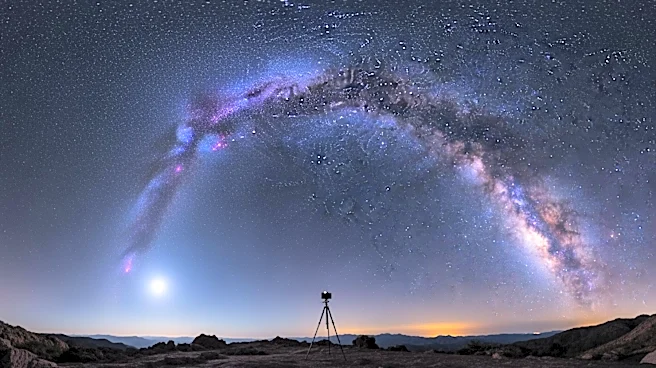
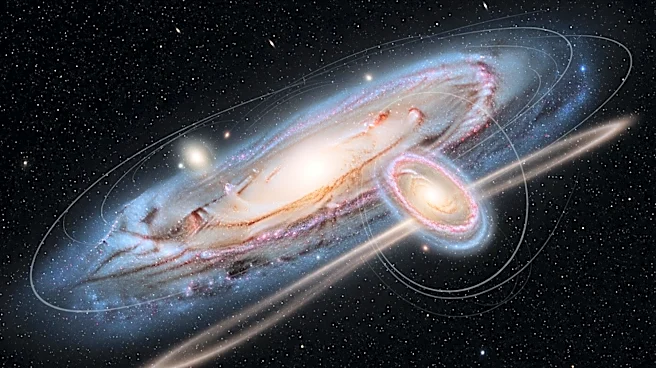
The Milky Way galaxy, our cosmic home, has a history marked by significant collisions and mergers, which have shaped its current structure. According to recent findings, the Milky Way was significantly altered by a past collision with a galaxy known as Gaia-Sausage-Enceladus,
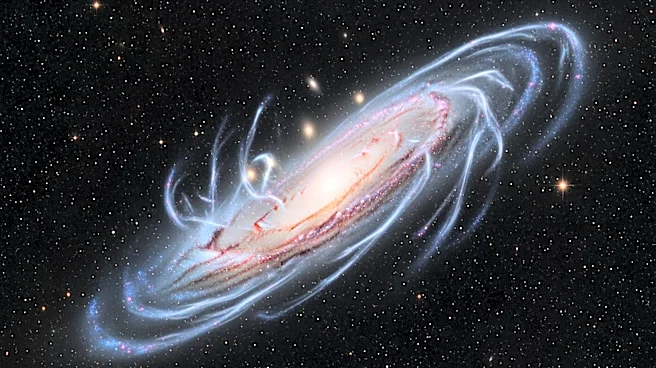
which occurred between 8 and 11 billion years ago. This event left behind a population of stars with unusual orbits and chemical compositions, serving as evidence of the galaxy's tumultuous past. Currently, the Milky Way is being influenced by the gravitational pull of the Large Magellanic Cloud (LMC), its most massive companion. This interaction is causing the Milky Way to undergo changes once again, as it is drawn into a complex gravitational dance with the LMC.
Why It's Important?
Understanding the Milky Way's past and ongoing interactions with other galaxies is crucial for astrophysics, as it provides insights into the processes that govern galaxy formation and evolution. The study of these cosmic events helps scientists map the distribution of dark matter, an elusive substance that plays a critical role in holding galaxies together. The current interaction with the LMC could lead to significant changes in the Milky Way's structure, affecting the distribution of stars and potentially altering the galaxy's future trajectory. These findings contribute to a broader understanding of cosmic dynamics and the forces that shape the universe.
What's Next?
As the Milky Way continues its interaction with the Large Magellanic Cloud, astronomers will closely monitor the changes in the galaxy's structure and dynamics. Future observations and data from space telescopes like Gaia will provide more detailed insights into the ongoing gravitational interactions. This research will help predict the long-term consequences of the Milky Way's encounter with the LMC, including potential changes in star formation rates and the galaxy's overall stability. The study of these cosmic events will also enhance our understanding of dark matter and its influence on galactic evolution.
Beyond the Headlines
The Milky Way's interactions with other galaxies highlight the dynamic and ever-changing nature of the universe. These events challenge the perception of the night sky as a symbol of permanence, revealing a history of survival and adaptation. The study of galactic mergers and collisions not only deepens our understanding of the cosmos but also underscores the interconnectedness of celestial bodies. As scientists continue to unravel the mysteries of the universe, these findings remind us of the complex and intricate dance of galaxies that has shaped the cosmos over billions of years.