
What's Happening?
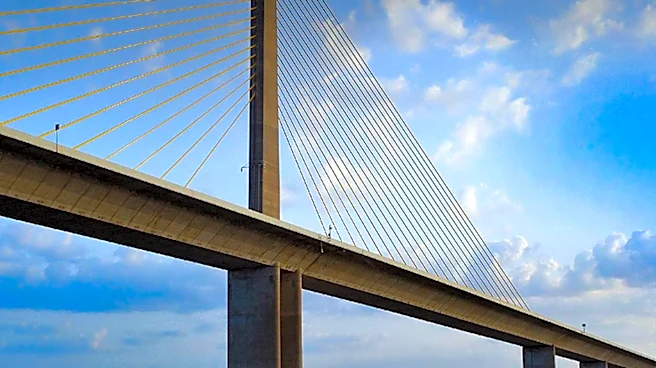
Rhode Island Governor Dan McKee is confronting a challenging re-election campaign for the 2026 Democratic primary, largely due to the ongoing controversy surrounding the Washington Bridge closure. The bridge, a critical Interstate 195 crossing connecting
Providence with its eastern suburbs, was partially closed in December 2023 after engineers discovered serious structural problems. This closure led to widespread traffic disruption and commuter frustration. While Governor McKee asserts he took decisive action for public safety, critics argue his administration's response was too slow and that he should have acted more aggressively. His decision to retain the state's transportation chief for over two years after the closure has also drawn criticism. The replacement bridge is now projected for completion in 2028, extending the disruption across much of McKee's political tenure. His main opponent, Helena Foulkes, a former CVS executive, is currently leading in polls and has positioned herself as a candidate for change.
Why It's Important?
The situation in Rhode Island highlights how infrastructure failures can quickly escalate into significant political issues, directly impacting public perception and electoral outcomes. The prolonged disruption caused by the Washington Bridge closure has become a central point of contention, demonstrating the tangible effects of infrastructure management on daily life and voter sentiment. For Governor McKee, the crisis represents a major test of his administration's accountability and effectiveness. For the Democratic Party in Rhode Island, a state that has not had a Republican governor since 2011, the primary challenge underscores potential anti-incumbency sentiments even within a dominant party. The outcome of this race could signal a broader trend in U.S. politics where voters prioritize tangible improvements in their daily lives, such as efficient infrastructure, when evaluating leadership. The legal actions taken by Rhode Island against companies involved in the bridge's prior work also underscore the financial and legal ramifications of such infrastructure failures.
What's Next?
The Democratic Party primaries in Rhode Island are scheduled for September 9, 2026, where Governor McKee will face Helena Foulkes. The ongoing construction of the replacement Washington Bridge, with an expected completion in 2028, will continue to be a prominent issue throughout the campaign. Governor McKee is expected to continue highlighting progress on the rebuilding project, including federal funding and ongoing construction, to counter criticism. Foulkes will likely maintain her focus on the administration's handling of the crisis and present herself as a fresh alternative. The legal disputes between Rhode Island and the companies previously involved with the bridge are also expected to continue, potentially revealing more details about the structural failures. The race will also be influenced by broader political dynamics, including any anti-incumbency sentiment in the state and the effectiveness of each candidate's campaign strategies, such as Foulkes's efforts to draw on prominent Democratic support.
Beyond the Headlines
The Washington Bridge controversy in Rhode Island extends beyond a mere transportation issue, touching upon deeper themes of governmental accountability, public trust, and the long-term implications of infrastructure investment. The prolonged disruption and the blame game between the state and contractors highlight the complexities of large-scale public works projects and the challenges of maintaining critical infrastructure. Ethically, the situation raises questions about the responsibility of public officials to ensure the safety and functionality of essential services, and the consequences when those responsibilities are perceived to be neglected. Culturally, the daily inconvenience faced by commuters can erode public confidence in government, fostering a demand for more transparent and efficient governance. This incident could also influence future infrastructure planning and funding decisions, potentially leading to more rigorous oversight and preventative maintenance strategies across the nation to avoid similar crises.