




What's Happening?
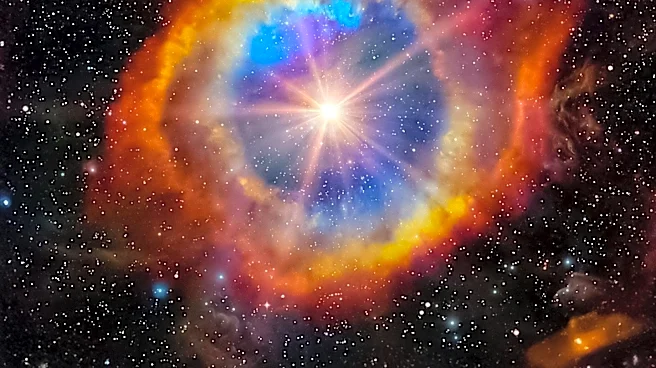
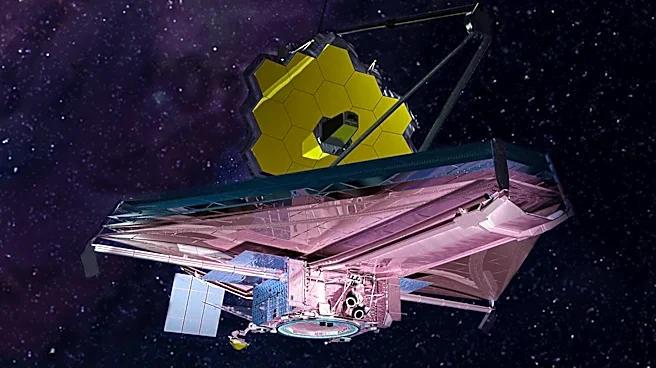
NASA's James Webb Space Telescope has provided new insights into the survival of a Jupiter-sized exoplanet, WD 1856 b, orbiting a white dwarf star, WD 1856+534, located about 80 light-years from Earth. This exoplanet was discovered in 2020 using NASA's TESS
and the retired Spitzer Space Telescope. The white dwarf, a remnant of a Sun-like star, should have engulfed nearby planets during its red giant phase. However, WD 1856 b orbits extremely close to the white dwarf, at a distance 50 times closer than Earth orbits the Sun. The Webb telescope's observations revealed that the planet is significantly warmer than expected, suggesting it survived the star's death by migrating inward due to gravitational interactions within its triple star system.
Why It's Important?
This discovery is significant as it offers a glimpse into the potential future of our solar system. In about five billion years, the Sun will become a red giant, potentially destroying the inner planets, including Earth. Understanding how WD 1856 b survived provides clues about the fate of gas giants like Jupiter. The study of such exoplanets helps scientists predict the long-term evolution of solar systems and the survival of planets after their host stars die. This research also enhances our understanding of planetary migration and the dynamics of multi-star systems, contributing to the broader field of astrophysics.
What's Next?
Further observations of WD 1856 b are planned to delve deeper into its atmospheric chemistry. The James Webb Space Telescope will continue to study similar exoplanets to gather more data on their composition and behavior. These studies will help refine models of planetary evolution and migration, offering more precise predictions about the future of our solar system. The ongoing research will also explore the potential habitability of planets orbiting white dwarfs, expanding the search for life beyond Earth.
Beyond the Headlines
The findings raise intriguing questions about the resilience of planetary systems and the potential for life in extreme environments. The presence of methane and other hydrocarbons in WD 1856 b's atmosphere suggests complex chemical processes that could inform the search for biosignatures on distant worlds. This research underscores the importance of international collaboration in space exploration, as the James Webb Space Telescope is a joint effort by NASA, ESA, and CSA. The study also highlights the role of advanced telescopes in pushing the boundaries of our knowledge about the universe.