
What's Happening?
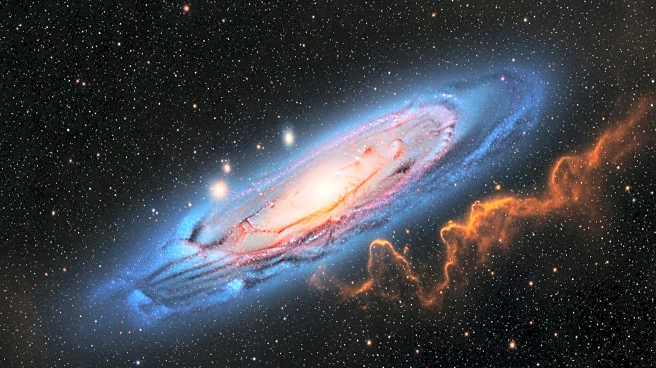
NASA's SPHEREx Observatory has successfully mapped the entire sky using 102 infrared colors, as revealed in an image released on December 18, 2025. This comprehensive mapping includes colors emitted by
stars, hot hydrogen gas, and cosmic dust. The infrared wavelengths, which are not visible to the human eye, provide a unique perspective on the cosmos. This data allows scientists to explore significant questions about the universe, such as the impact of events occurring shortly after the Big Bang on the distribution of galaxies. Additionally, the data will help researchers understand the evolution of galaxies over nearly 14 billion years and investigate the distribution of essential life ingredients within our galaxy.
Why It's Important?
The SPHEREx Observatory's mapping of the sky in infrared colors is a significant advancement in cosmic research. By providing a detailed view of the universe's structure and composition, this data can enhance our understanding of galaxy formation and evolution. It also offers insights into the early universe's conditions, potentially leading to breakthroughs in cosmology. The ability to study the distribution of life-essential elements in our galaxy could have profound implications for understanding life's potential beyond Earth. This research supports NASA's broader mission of exploring space and expanding human knowledge of the universe.
What's Next?
The data collected by SPHEREx will be analyzed by scientists to answer fundamental questions about the universe's history and structure. Researchers will focus on how galaxies have evolved and the role of cosmic events in shaping the universe. The findings could influence future space missions and guide the development of new technologies for space exploration. As the analysis progresses, the scientific community may propose new theories or revise existing models of the universe, potentially leading to further exploration initiatives.
Beyond the Headlines
The SPHEREx Observatory's work highlights the importance of infrared astronomy in uncovering hidden aspects of the universe. This approach allows scientists to observe phenomena that are invisible in other wavelengths, offering a more comprehensive understanding of cosmic processes. The project also underscores the collaborative nature of space exploration, involving multiple scientific disciplines and international partnerships. As the data is shared and analyzed, it may inspire new collaborations and innovations in space science.