







What's Happening?
A recent study published in Nature Climate Change highlights the critical role of boreal forests in maintaining permafrost stability and preventing carbon release. The research, conducted by an international team from institutions including Humboldt University
of Berlin and Vrije Universiteit Amsterdam, reveals that the dense canopies of boreal forests act as natural sunshields. These canopies significantly reduce summer soil thawing by about one meter compared to treeless areas, thereby keeping approximately 59 billion tonnes of carbon frozen in the ground. This discovery underscores a previously overlooked natural service that standard climate models have not accounted for. The study utilized satellite imagery, map data, and computer models to track heat movement between the air, tree leaves, and frozen ground across 16 northern regions.
Why It's Important?
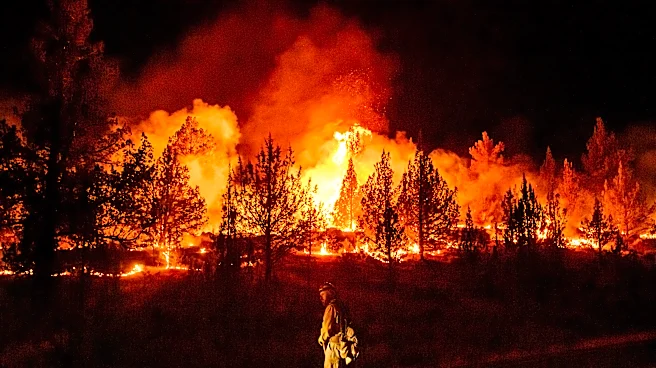
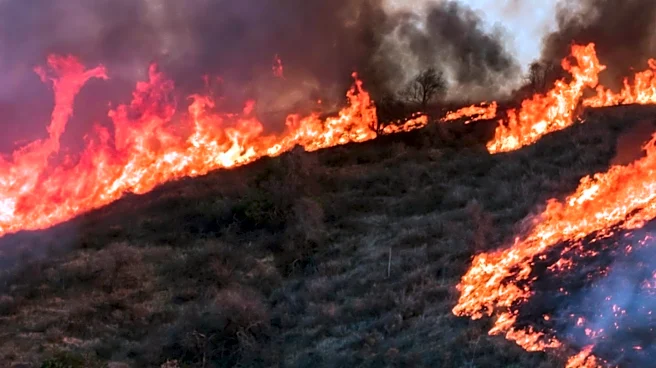
The findings of this study are significant for global climate change mitigation efforts. Boreal forests, which span across regions like Canada, Alaska, and Russia, play a vital role in the global carbon cycle. The preservation of these forests is crucial as they prevent the release of vast amounts of carbon dioxide and methane, potent greenhouse gases, into the atmosphere. The study highlights the potential consequences of deforestation and wildfires, which not only release carbon stored in trees but also expose the permafrost to direct sunlight, accelerating thawing and further carbon release. Protecting these forests is essential to maintaining the Earth's climate balance and preventing a feedback loop of warming and permafrost melting.
What's Next?
The study calls for increased efforts to protect boreal forests from deforestation and wildfires, which are becoming more frequent due to climate change. Policymakers and environmental organizations may need to implement stricter conservation measures and promote reforestation to maintain the cooling effect of forest canopies. Additionally, further research could focus on integrating these findings into climate models to improve predictions and inform global climate policy. The study also suggests that understanding the role of boreal forests in the carbon cycle could lead to more effective strategies for mitigating climate change impacts.
Beyond the Headlines
The research sheds light on the complex interactions between forest ecosystems and climate regulation. It emphasizes the importance of considering natural climate solutions, such as forest conservation, in addressing global warming. The study also raises awareness about the potential long-term impacts of losing boreal forests, which could lead to irreversible changes in the Earth's climate system. This underscores the need for a holistic approach to climate policy that includes both technological innovations and the preservation of natural ecosystems.