




What's Happening?
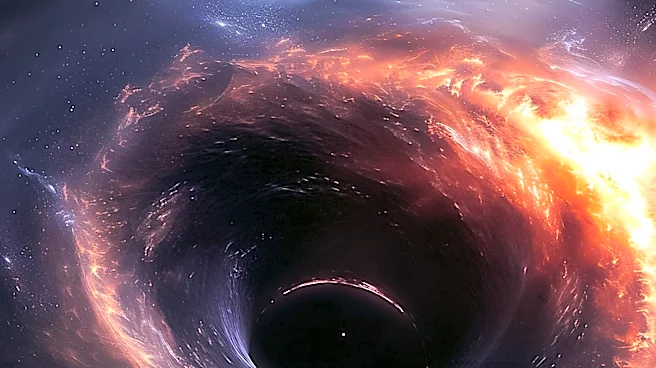
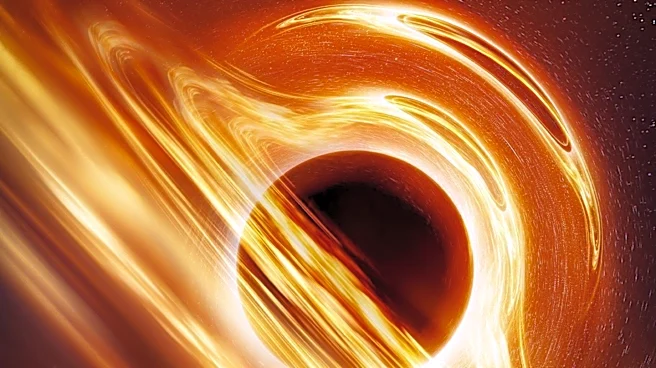
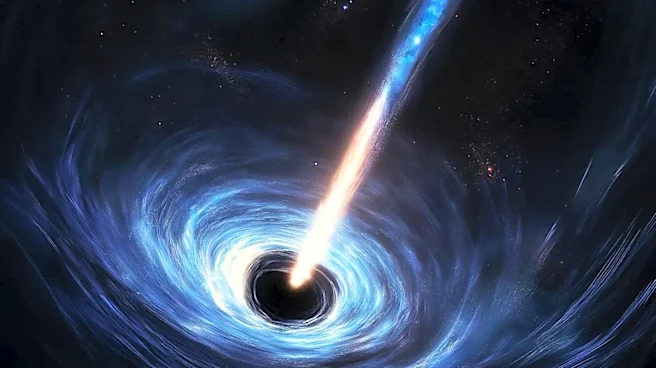
Recent discussions in astrophysics have highlighted the extreme effects of black holes on time and space. As objects approach a black hole's event horizon, time appears to slow dramatically from an outside observer's perspective, a phenomenon predicted
by general relativity. This effect, known as gravitational time dilation, has been confirmed in various experiments, including those involving atomic clocks. The concept is that while an object seems to freeze at the event horizon to a distant observer, it actually continues inward in its own time frame. This paradoxical nature of black holes continues to intrigue scientists, as it challenges our understanding of time and space.
Why It's Important?
Understanding black holes is crucial for advancing our knowledge of the universe and the fundamental laws of physics. The study of time dilation near black holes not only tests the limits of general relativity but also provides insights into the nature of gravity and spacetime. These findings have implications for theoretical physics, particularly in the quest to reconcile general relativity with quantum mechanics. Moreover, the ability to measure and predict these phenomena enhances our capability to explore and understand cosmic events, potentially leading to new technological advancements.