
What's Happening?
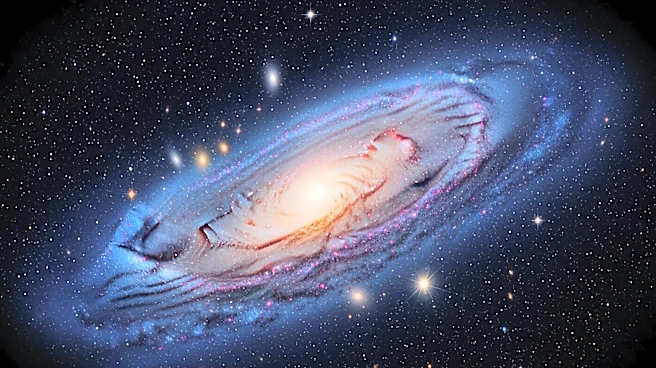
Astrophysicists are debating whether the Large Magellanic Cloud (LMC) is approaching the Milky Way for the first time or if it has done so before. A recent study using computer simulations of the gas halos
of both galaxies supports the 'first-pass' theory, contradicting the 'second passage' hypothesis. The LMC, the Milky Way's largest satellite galaxy, is about 160,000 light-years away. The study used the GIZMO simulation package to model the interaction of gas particles, comparing simulated data with actual ultraviolet observations. The findings suggest the LMC's current approach is its first, as the 'second passage' model could not account for the observed gas velocity and distribution.
Why It's Important?
The approach of the LMC has significant implications for the evolution of the Milky Way. Understanding whether this is the first or a repeated encounter can provide insights into the dynamics of galaxy interactions and the role of dark matter. The study's findings challenge previous theories and highlight the complexity of galactic movements. Resolving this debate could enhance our understanding of the Milky Way's history and its future interactions with neighboring galaxies.
What's Next?
Further research is needed to address the limitations of the current model, such as the exclusion of the Small Magellanic Cloud and the simplification of the LMC's corona. NASA's upcoming Aspera mission may provide more definitive data on the Magellanic gas distribution, potentially settling the debate. Continued observations and simulations will be crucial in refining our understanding of these galactic interactions.