
What's Happening?
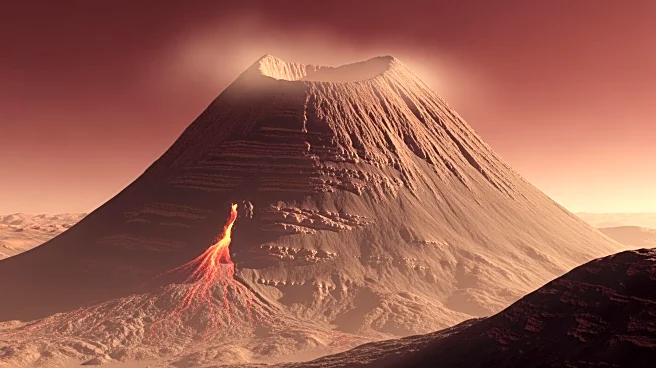
NASA has made a significant discovery on Olympus Mons, the largest volcano in the Solar System, located on Mars. Rising more than twice the height of Mount Everest, Olympus Mons is a shield volcano formed
by the steady outflow of low-viscosity lava. This discovery challenges existing knowledge about planetary activity in the absence of tectonic plates. The volcano's massive size and unique structure have intrigued scientists since its discovery, with its summit caldera being almost 3 km deep and 25 km across. The lack of tectonic plate movement on Mars has allowed Olympus Mons to grow to its current size, as lava has accumulated in the same location for millions of years.
Why It's Important?
The discovery on Olympus Mons provides valuable insights into Martian volcanic history and planetary geology. Understanding the formation and growth of such a massive volcano without tectonic activity offers clues about the geological processes on Mars. This knowledge can inform future exploration and study of the planet, potentially aiding in the search for past or present life. The findings also contribute to comparative planetology, helping scientists draw parallels and distinctions between Earth and Mars, particularly in terms of volcanic activity and planetary evolution.
What's Next?
Future research will likely focus on further exploring Olympus Mons and its surrounding region to gain a deeper understanding of Martian geology. Scientists may conduct additional studies to determine the age and composition of the volcanic layers, as well as the potential for past volcanic activity. These efforts could involve advanced imaging techniques and data analysis from current and future Mars missions. The findings may also influence the planning of future missions to Mars, including potential human exploration.