







What's Happening?
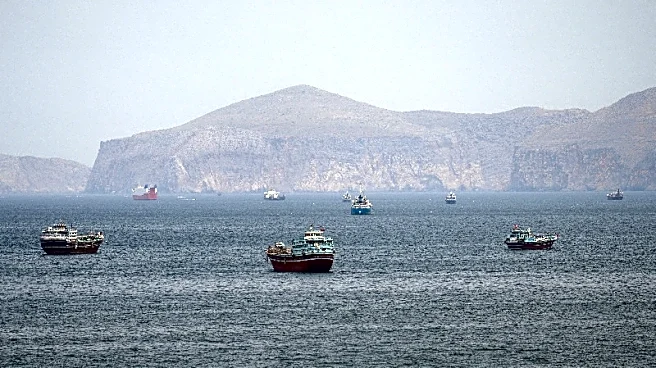
France has drafted a United Nations Security Council resolution aimed at establishing an international mission to restore freedom of navigation in the Strait of Hormuz. This move comes as the United States faces challenges in advancing its own resolution,
co-sponsored with Bahrain, which demands that Iran cease attacks and mining activities in the Strait. The US-Bahraini resolution has been stalled due to potential vetoes from China and Russia, who argue that the resolution is biased against Tehran. France, a permanent member of the Security Council, has not yet supported the US text but is preparing its own initiative to address the situation. French President Emmanuel Macron has indicated that France is working on an international mission to ensure the free movement of vessels in the Strait, a critical passage for global energy trade.
Why It's Important?
The Strait of Hormuz is a strategic chokepoint for global oil shipments, and its closure has significant implications for international energy markets, leading to increased oil prices. The ongoing US-Iran tensions and the potential for military conflict in the region pose risks to global economic stability. France's initiative reflects a diplomatic effort to de-escalate tensions and ensure the security of this vital waterway. The involvement of multiple countries in co-sponsoring the US resolution highlights the international community's concern over the situation. However, the differing positions of major powers like China, Russia, and France underscore the complexities of achieving a consensus at the UN level.
What's Next?
The next steps involve continued diplomatic negotiations at the United Nations to find a resolution that can gain broad support, including from veto-wielding members like China and Russia. France's proposal may serve as a compromise or alternative to the US-Bahraini resolution, potentially facilitating a unified international response. The timing of the vote on the US-Bahraini resolution remains uncertain, and further discussions are expected. The outcome of these diplomatic efforts will significantly impact the geopolitical dynamics in the Middle East and the stability of global energy markets.