

What's Happening?
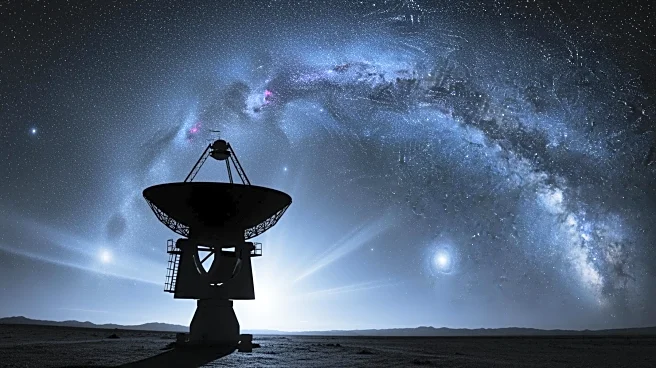
The Atacama Cosmology Telescope (ACT) in Chile has released its final dataset, revealing significant challenges to existing cosmological models. Over its operational period, ACT provided high-resolution observations of the cosmic microwave background
(CMB), focusing on its polarization. The data has confirmed the existence of the 'Hubble tension,' a discrepancy between the observed expansion rate of the universe and predictions based on early-universe measurements. The ACT data tested around 30 extended cosmological models, all of which failed to resolve the tension. This finding underscores the complexity of the universe's expansion and the limitations of current theoretical models.
Why It's Important?
The confirmation of the Hubble tension by ACT's data highlights a major unresolved issue in cosmology, challenging the standard model of the universe. This tension suggests that our understanding of the universe's expansion and the forces driving it may be incomplete. The failure of multiple models to account for this discrepancy indicates the need for new theories or modifications to existing ones. This could lead to significant advancements in cosmological research, potentially altering our understanding of dark matter, dark energy, and the fundamental forces shaping the universe.
What's Next?
Researchers will continue to analyze the ACT data to explore alternative explanations for the Hubble tension. Future telescopes and missions, such as the European Space Agency's Euclid and NASA's Roman Space Telescope, may provide additional insights. These efforts will focus on refining measurements of the universe's expansion and testing new theoretical models. Collaboration between observational and theoretical cosmologists will be crucial in addressing this challenge and advancing our understanding of the cosmos.