


What's Happening?
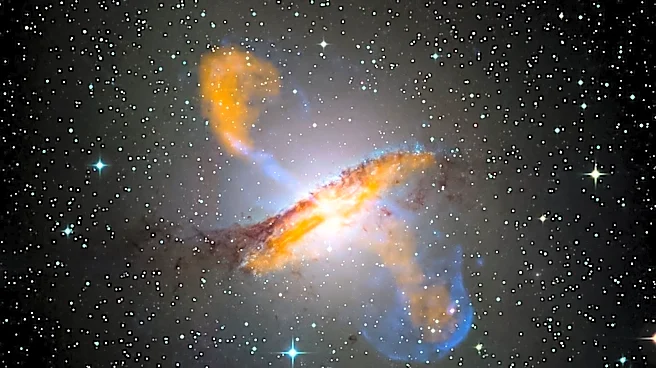
Scientists have discovered three supermassive black holes on the verge of collision within a single distant galaxy, cataloged as J0148-4214. This galaxy is so far away that its light has taken 12.5 billion years to reach Earth, meaning we are observing
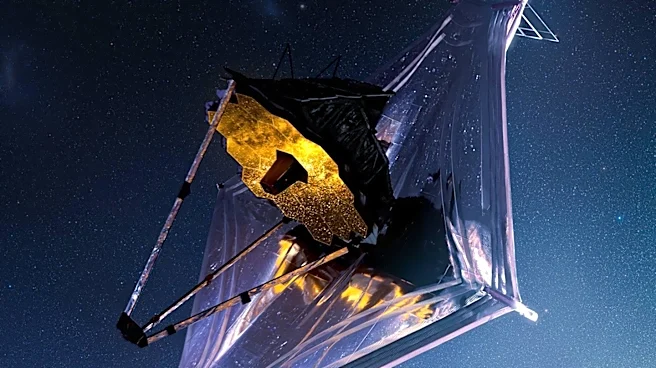
it as it was less than 1.3 billion years after the Big Bang. This finding provides strong evidence that black holes grew rapidly in the early universe through mergers. The discovery was made using the James Webb Space Telescope (JWST), specifically its Integrated Field Spectroscopy unit on the Near Infrared Spectrometer (NIRSpec), which measured the motion of hydrogen gas swirling around the accretion disks of each black hole. Two of the black holes are located at the center of J0148-4214, separated by 620 light-years, with masses of 80 million and 600,000 times the mass of our sun, respectively. The third black hole, with a mass of two million solar masses, is situated 5,500 light-years from the galaxy's center.
Why It's Important?
This discovery is crucial for understanding the early universe and the rapid growth of supermassive black holes. It supports the theory that black hole mergers were a significant mechanism for their swift expansion shortly after the Big Bang. The observation of three active black holes in a single distant galaxy is unprecedented and offers a unique laboratory for studying the dynamics of such extreme cosmic events. The data from JWST not only identified these black holes but also allowed scientists to estimate their masses and accretion rates, providing valuable insights into their evolution. This research contributes to our knowledge of galaxy formation and evolution, as supermassive black holes are believed to play a critical role in these processes. Furthermore, it sets the stage for future gravitational-wave observatories, like the planned Laser Interferometer Space Antenna (LISA), which will be designed to detect the long-wavelength gravitational waves produced by the mergers of supermassive black holes.
What's Next?
While the discovery confirms the presence of three black holes, the exact future of their interaction remains part of the 'three-body problem' in physics. It is uncertain whether the third black hole will merge with the central pair or be flung out of the galaxy. Future observations and theoretical modeling will be necessary to predict the long-term dynamics of this system. The European Space Agency's LISA mission, planned for the mid-2030s, is designed to detect gravitational waves from supermassive black hole mergers, which could provide direct evidence of such events in the distant universe. This discovery will likely spur further research into similar multi-black hole systems and the mechanisms driving their formation and evolution in the early cosmos. Scientists will continue to use advanced telescopes like JWST to probe the distant universe for more such phenomena.
Beyond the Headlines
The observation of three supermassive black holes on a collision course in the early universe offers a profound glimpse into the extreme conditions that shaped the cosmos. It challenges our understanding of how quickly massive structures could form and interact after the Big Bang. This phenomenon highlights the violent and dynamic nature of galactic evolution, where mergers and gravitational interactions are fundamental drivers. The 'three-body problem' aspect of this discovery underscores the inherent complexity and unpredictability of multi-object gravitational systems, even at cosmic scales. Ethically, this research expands humanity's knowledge of its place in the universe, pushing the boundaries of scientific inquiry and inspiring awe at the vastness and power of cosmic forces. It also emphasizes the continuous advancement of astronomical technology, with JWST providing unprecedented capabilities to observe the universe's earliest moments.