







What's Happening?
President Bola Tinubu has announced that Nigeria has moved beyond the emergency phase of economic reforms, signaling a new policy direction focused on translating macroeconomic gains into shared prosperity, industrial expansion, and improved living conditions.
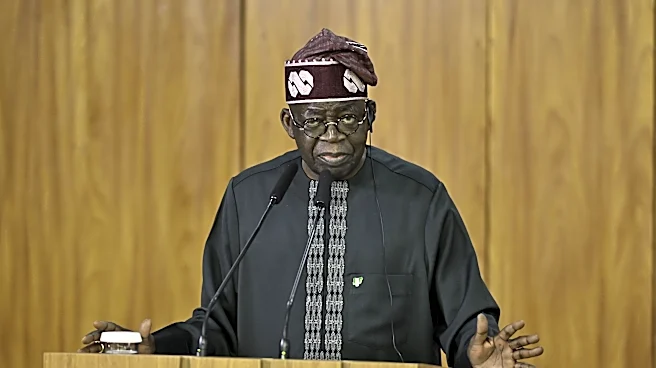
Speaking through the Speaker of the House of Representatives, Tajudeen Abbas, at a book presentation, President Tinubu highlighted that difficult economic decisions made since May 2023 are yielding results. He reported that Nigeria's external reserves have risen to approximately $55 billion, and non-oil exports have exceeded $6 billion, marking the highest level in the nation's history. The administration is now shifting its focus from economic stabilization to expanding productive capacity, creating jobs, improving electricity supply, increasing domestic production, and providing affordable housing. President Tinubu acknowledged that economic growth figures alone are insufficient, emphasizing that the ultimate measure of reforms will be their impact on households and businesses. He outlined the ambition of building a $1 trillion economy by 2030 under the Medium-Term National Development Plan 2026–2030, noting that non-oil activities now account for about 96 percent of GDP and non-oil revenue increased from N13.63 trillion in 2023 to N16.4 trillion in the first half of 2026.
Why It's Important?
This declaration marks a significant pivot in President Tinubu's economic strategy, moving from immediate crisis management to long-term development and wealth creation. It signals to both domestic and international stakeholders that the initial, often painful, phase of reforms is considered complete, and the focus is now on leveraging those changes for broader economic benefits. The reported increases in external reserves and non-oil exports are crucial indicators of economic stabilization and diversification, potentially boosting investor confidence. The ambitious target of a $1 trillion economy by 2030 sets a clear, measurable goal for the administration and provides a framework for future policy decisions. By emphasizing shared prosperity and improved living conditions, the government aims to address public concerns about the impact of reforms on ordinary citizens, suggesting that the benefits will soon trickle down. This shift is vital for maintaining public support and ensuring the sustainability of the reform agenda, as the administration seeks to demonstrate tangible improvements in daily life.
What's Next?
The next phase of President Tinubu's economic program will likely involve intensified efforts to attract private sector investment, which is targeted to provide 86% of the investment needed to achieve the 2030 goals. The government is expected to implement policies that foster industrial expansion, job creation, and improvements in critical sectors like power and housing. This may include further regulatory reforms, tax incentives, and infrastructure development projects. The administration will need to demonstrate how macroeconomic gains translate into tangible improvements for households and businesses, such as reduced inflation, increased employment opportunities, and better access to essential services. Monitoring the growth of non-oil sectors and the continued increase in non-oil revenue will be key performance indicators. Additionally, the government will likely engage in strategic partnerships and international collaborations to secure the necessary capital and expertise for its ambitious development plans. Public communication will focus on showcasing progress in these areas to build confidence and support for the long-term vision.
Beyond the Headlines
The declaration of an end to 'emergency reforms' and the unveiling of a 'shared prosperity plan' signify a crucial transition in Nigeria's economic narrative. This shift attempts to move beyond the immediate pain of austerity measures towards a more hopeful vision of economic growth and improved welfare. However, the challenge lies in effectively translating macroeconomic statistics into tangible benefits for the populace, especially in a country with significant income inequality. The ambitious $1 trillion economy target by 2030, while inspiring, requires sustained double-digit economic growth and substantial investment, as highlighted by Governor Chukwuma Soludo. This underscores the need for not just policy formulation but also robust implementation, institutional strengthening, and a conducive environment for private sector participation. The ethical dimension involves ensuring that the benefits of economic growth are equitably distributed and do not exacerbate existing social disparities. The long-term success of this plan will depend on the government's ability to foster inclusive growth, create sustainable jobs, and improve the overall quality of life for all Nigerians, moving beyond mere statistical achievements to real human development.