





What's Happening?
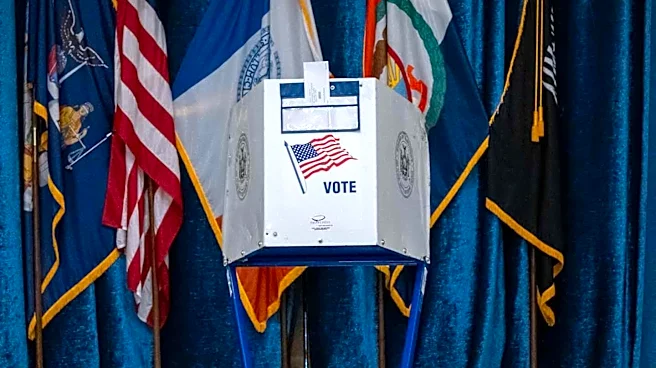
Randy Mastro, a former federal prosecutor and public servant, is advocating for open primaries in New York City, arguing that the current partisan primary system disenfranchises a significant portion of the electorate. Mastro, who has held high-level
positions in two City Hall administrations, discussed this issue on 'The Point with Marcia Kramer'. He highlighted that approximately 1.1 million New Yorkers, registered as independents, are excluded from participating in primary elections. Mastro contends that this system allows a small number of primary voters to effectively decide general election outcomes, particularly in heavily Democratic areas like New York City, where the Democratic primary winner often becomes the presumptive general election winner. He points out that over 80% of major U.S. cities with populations exceeding 500,000 utilize open primaries.
Why It's Important?
The push for open primaries in New York City carries significant implications for democratic participation and local governance. By excluding independent voters, the current system limits the influence of a substantial segment of the population on who represents them. This can lead to elected officials who are primarily beholden to their party's base rather than the broader electorate, potentially hindering effective governance on non-partisan issues such as public services. Mastro's argument that 'there's no Republican or Democrat way to pick up the garbage' underscores the idea that local government functions should transcend partisan divides. Implementing open primaries could foster greater civic engagement, encourage more moderate candidates, and ensure that elected officials are more representative of the entire community's interests, rather than just those of a specific party affiliation.
What's Next?
Randy Mastro's advocacy for open primaries is currently being pursued through lawsuits against New York City. The outcome of these legal challenges will determine the immediate future of primary election reform in the city. Should Mastro's lawsuits succeed, it could lead to a significant overhaul of the electoral process, potentially allowing 1.1 million independent voters to participate in primaries. This change would likely alter the dynamics of local elections, potentially leading to a broader range of candidates and more competitive races. Conversely, if the lawsuits are unsuccessful, the current partisan primary system will remain in place, continuing to exclude independent voters from the initial stages of candidate selection. The debate also highlights a broader national discussion about electoral reform and voter access.
Beyond the Headlines
The debate over open primaries in New York City touches upon fundamental questions about the nature of democracy and representation in urban environments. The current system, by effectively ceding significant power to a relatively small number of primary voters, raises concerns about the legitimacy and inclusivity of local governance. Mastro's reference to Fiorello LaGuardia's philosophy—that local issues are non-partisan—suggests a deeper critique of how partisan politics can impede effective municipal administration. The ethical dimension lies in whether a system that excludes a large segment of the voting population from a crucial stage of the electoral process truly serves the public good. A shift to open primaries could foster a more collaborative political culture, potentially leading to more pragmatic solutions for urban challenges by encouraging candidates to appeal to a wider, more diverse electorate.