







What's Happening?
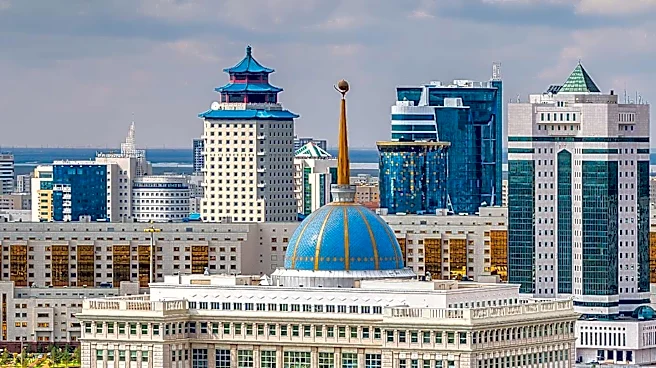
Kazakhstan, like other middle powers, is striving to build a new AI economy while navigating the widening technological divide between the United States and China. The Central Asian nation relies on technology from both countries to develop its AI ecosystem.
This approach is evident in the increasing presence of Chinese cars, such as BYD and Changan, on Astana's streets, which are making inroads into a market previously dominated by South Korean brands like Hyundai and Kia. Despite the growing commercial footprint of Chinese tech, Kazakhstan also engages with American tech giants, indicating a balanced strategy to leverage advancements from both global powers without exclusively aligning with either.
Why It's Important?
Kazakhstan's strategy of balancing technological reliance on both the U.S. and China holds significant implications for U.S. tech companies and policymakers. For U.S. businesses, it highlights the competitive landscape in emerging markets, where Chinese tech is rapidly gaining ground. This necessitates a re-evaluation of market penetration strategies and competitive advantages. For U.S. policymakers, it underscores the challenge of maintaining technological influence in regions where countries are actively seeking diversification rather than exclusive partnerships. The ability of middle powers like Kazakhstan to leverage technology from both sides could dilute the impact of U.S. efforts to create a unified tech bloc, potentially affecting global standards and supply chains. This situation also presents an opportunity for U.S. companies to demonstrate superior innovation and reliability to secure their market share.
What's Next?
Kazakhstan is expected to continue its dual-pronged approach, seeking technological advancements and investments from both the U.S. and China to fuel its AI revolution. This will likely involve further collaborations with tech companies from both nations, potentially leading to a hybrid technological infrastructure. The U.S. and China will likely intensify their efforts to influence Kazakhstan's technological development through various incentives, investments, and diplomatic engagements. The outcome will depend on Kazakhstan's ability to maintain its strategic autonomy while benefiting from both powers, and on the competitive offerings from U.S. and Chinese tech firms. This dynamic will be a key indicator of how other middle powers might navigate the global tech rivalry.
Beyond the Headlines
Kazakhstan's balancing act in the tech sphere reflects a broader geopolitical trend where middle powers are increasingly asserting their independence and refusing to be drawn into exclusive alliances. This approach challenges the traditional bipolar or unipolar models of global influence, suggesting a more multipolar world where countries prioritize their national interests by engaging with multiple major powers. Ethically, it raises questions about data sovereignty and technological dependence, as integrating diverse tech ecosystems can introduce complexities in security and regulatory frameworks. Culturally, it could lead to a blend of technological influences, shaping unique digital landscapes. This strategy could also inspire other nations to adopt similar non-aligned tech policies, further decentralizing global technological power.