



What's Happening?
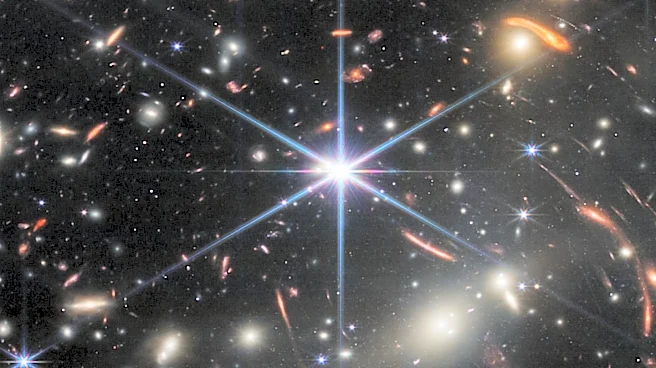
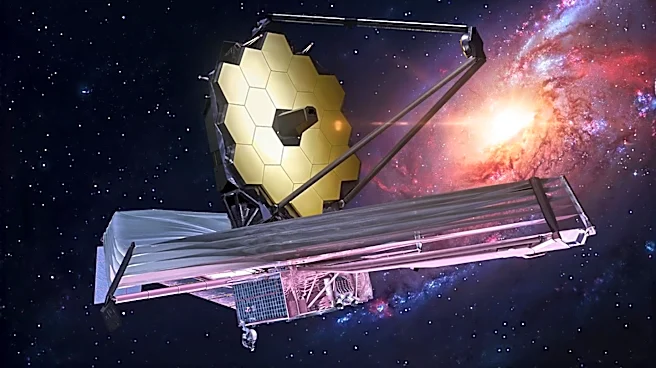
The James Webb Space Telescope (JWST) has identified a compact red source, MoM-BH*-1, in the early universe, approximately 660 million years after the Big Bang. Initially, its spectrum made it appear similar to an enormous star. However, astronomers,
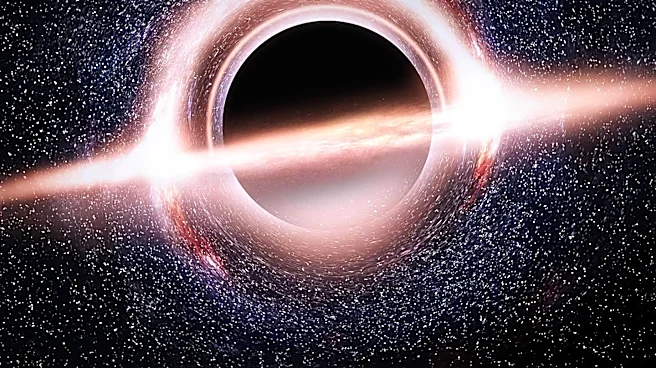
led by Rohan Naidu, determined that its total light output is roughly 100 billion times the Sun’s luminosity, a level unsustainable by any ordinary star. The preferred explanation is a feeding black hole surrounded by an extraordinarily dense envelope of hydrogen. The JWST's NIRSpec instrument observed a significant drop in measured flux between three and four micrometers, a feature known as the Balmer break. While stellar populations produce this break, MoM-BH*-1's break strength of 7.7 far exceeds the typical peak of 3 for a dust-free stellar population, or even 5 for an extreme population of A-type stars. This, combined with broad hydrogen emission and deep hydrogen absorption, led to the conclusion that a normal collection of stars could not explain the observations.
Why It's Important?
This discovery is important for understanding the evolution of black holes and galaxies in the early universe. The 'black hole star' model suggests a mechanism by which black holes could have grown rapidly to supermassive sizes, potentially influencing the formation and evolution of early galaxies. The ability of dense hydrogen to mimic a stellar spectrum provides a new lens through which to interpret observations of distant cosmic objects. It challenges previous assumptions about the nature of bright, compact sources in the early universe, particularly the 'Little Red Dots' that have puzzled astronomers. If this hydrogen cocoon model proves to be a common phenomenon, it could lead to a re-evaluation of how many early universe objects are classified, shifting some from stellar populations to accreting black holes. This could significantly alter our understanding of the cosmic dawn and the processes that shaped the universe we see today.
What's Next?
The current 'black hole star' picture is the authors' best-fitting interpretation and not yet a settled consensus. Future observations and modeling will be crucial to test this hypothesis. Astronomers will likely seek to identify more objects exhibiting similar spectral characteristics, particularly the extreme Balmer break and the combination of broad hydrogen emission and deep absorption. If future sources consistently show these features, the hydrogen cocoon model could transition from an elegant explanation for a single object to a recognized stage in early black-hole growth. Further research will also focus on refining the models of gas density, turbulent velocity, and the original spectrum from the accretion flow, as the current model is described as simple and idealized. The goal is to confirm the prevalence of such 'disguised' black holes and their role in the early universe's development.
Beyond the Headlines
The finding has profound implications for astrophysics and cosmology. It highlights the complexity of interpreting astronomical data, where seemingly straightforward observations can mask entirely different underlying phenomena. The concept of a black hole 'disguised' as a star underscores the need for sophisticated modeling and multi-wavelength observations to unravel the true nature of distant cosmic objects. This discovery could also influence theoretical models of black hole seed formation and growth, potentially providing observational evidence for mechanisms that allow black holes to accumulate mass at an accelerated rate. Furthermore, it opens up new avenues for understanding the interplay between black holes and their host environments in the nascent universe, suggesting that dense gas envelopes played a critical role in shaping their observable properties and evolutionary paths.