



What's Happening?
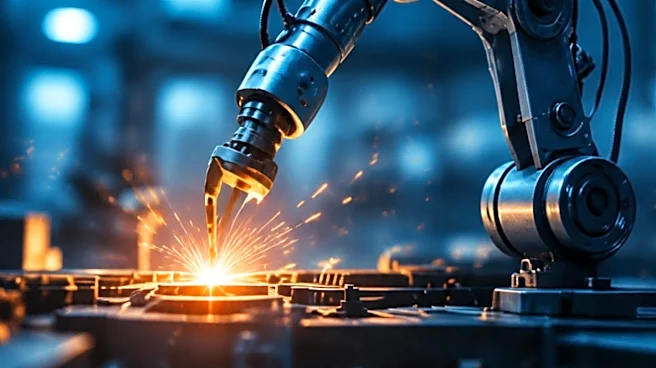
NASA is funding research at the University of Illinois Chicago (UIC) led by Assistant Professor Azadeh Haghighi to develop intelligent welding technology for deep-space exploration. This project, named 'Weld-ASSIST: Weldability Assessment for In-Space
Conditions using a Digital Twin,' aims to address the unique challenges of welding in space, such as extreme temperatures, vacuum, and microgravity. These conditions degrade weldability, alter chemical composition, and lead to defects like porosity. Haghighi's team is developing a digital twin platform that integrates multi-scale multi-physics models with physics-informed machine learning and uncertainty quantification techniques to evaluate welding processes under these extreme conditions. The research is crucial for NASA's long-term goals of in-space manufacturing and assembly for Moon and Mars missions, which will reduce logistical burdens and reliance on Earth-based supplies.
Why It's Important?
The development of reliable in-space welding technology is a critical enabler for future U.S. deep-space missions. Currently, the logistical challenges and costs associated with transporting pre-fabricated structures from Earth are immense. The ability to manufacture and repair structures in space will significantly reduce mission costs, increase operational flexibility, and enhance the safety and structural integrity of spacecraft and habitats. This research directly supports NASA's vision for sustainable human presence beyond Earth, allowing for the construction and maintenance of lunar bases and Martian outposts using locally sourced materials. Furthermore, the integration of artificial intelligence and computational modeling in this project represents a significant advancement in manufacturing science, with potential applications not only in space but also for advanced manufacturing technologies on Earth, fostering innovation and a skilled workforce in critical engineering fields.
What's Next?
The research will continue to develop and refine the digital twin platform, with models being validated through Earth-based experiments, parabolic flight tests, and existing public data. This validation process is essential to ensure the accuracy and reliability of the welding predictions under space conditions. The project aims to establish fundamental scientific knowledge that will minimize trial-and-error, enabling high-quality, one-shot welds in space and reducing the need for reworks. Future efforts will also focus on extending these models to support resource utilization on the Moon and Mars, including construction and repair using materials like regolith. The project will continue to provide UIC students with opportunities to engage in cutting-edge research, preparing them for careers in aerospace and advanced manufacturing.
Beyond the Headlines
This research has profound implications beyond just welding in space. It represents a paradigm shift in manufacturing, moving towards highly intelligent, autonomous systems capable of operating in extreme environments with minimal human intervention. The concept of a 'digital twin' for complex manufacturing processes, especially under uncertain conditions, is a frontier in engineering. Ethically, the ability to repair and construct in space could reduce the amount of debris generated by discarded components, contributing to a more sustainable space environment. Culturally, it signifies humanity's growing capability to not just visit, but to live and work in space, transforming space exploration from transient missions to permanent outposts. The interdisciplinary nature of this research, combining physics, computation, AI, and engineering, also highlights the evolving demands on future STEM professionals, requiring a holistic approach to complex problem-solving.