







What's Happening?
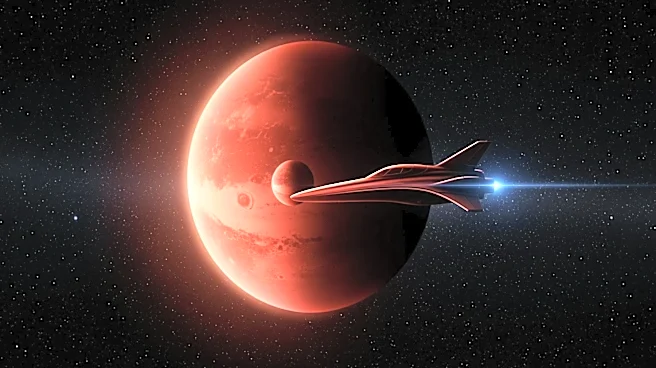
NASA's Psyche mission has captured a colorized image of Mars as the spacecraft approaches the planet for a gravity assist scheduled for May 15, 2026. This maneuver is intended to increase the spacecraft's speed and adjust its trajectory towards the asteroid
Psyche, with an expected arrival in 2029. The image, taken from about 3 million miles away, shows Mars as a thin crescent, similar to the Moon's crescent phase. The observation was made using the spacecraft's multispectral imager instrument with a panchromatic filter, capturing sunlight reflected off Mars and scattered by atmospheric dust. The image also highlights Mars' icy north polar cap, currently in winter, where seasonal clouds and hazes may be forming. This imaging is part of the mission's efforts to calibrate the cameras and prepare for the asteroid approach.
Why It's Important?
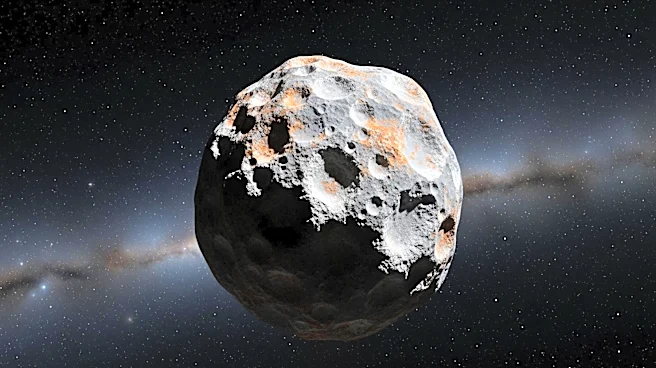
The Psyche mission's gravity assist at Mars is a critical step in its journey to the asteroid Psyche, which is believed to be composed largely of metallic iron and nickel, similar to Earth's core. Studying this asteroid could provide insights into the building blocks of planet formation and the history of our solar system. The mission's success in capturing detailed images of Mars also demonstrates the capabilities of its imaging technology, which will be crucial for the mission's primary objective. Additionally, the mission contributes to NASA's broader goals of exploring and understanding celestial bodies, which can have implications for future space exploration and potential resource utilization.
What's Next?
Following the gravity assist, the Psyche spacecraft will continue its journey towards the asteroid Psyche, with an expected arrival in 2029. The mission team will continue to analyze the images and data collected during the Mars flyby to refine their understanding of the spacecraft's instruments and trajectory. This data will also help in planning the approach and study of the asteroid. The mission's progress will be closely monitored by NASA and the scientific community, as it holds the potential to unlock new knowledge about the solar system's formation and evolution.