



What's Happening?
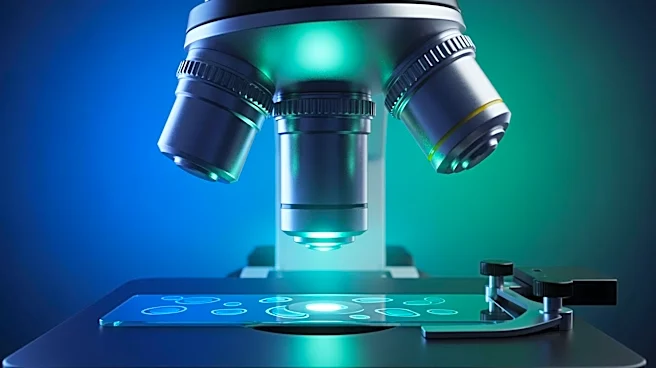
Engineers at the University of California San Diego have developed a new AI-enhanced microscopy technique that allows for real-time video imaging of live cells. This advancement, published in Nature Communications, utilizes an algorithm that significantly
improves the speed and quality of image capture compared to traditional methods. The technique, known as unrolled blind-SIM (UBSIM), integrates artificial intelligence into the image reconstruction process, enabling the production of high-quality images at a much faster rate. This method builds on structured illumination microscopy (SIM), which is known for its ability to enhance image detail while minimizing light exposure to cells. The new approach addresses previous challenges with SIM, such as the need for precise calibration and slow image processing, by using AI to streamline the process and avoid introducing false details.
Why It's Important?
The development of UBSIM represents a significant advancement in the field of microscopy, particularly for biological research. By enabling real-time, high-resolution imaging of live cells, this technology can greatly enhance the ability of scientists to observe and understand cellular processes as they occur. This could lead to new insights in cell biology and potentially accelerate discoveries in medical research. The integration of AI into this process not only improves the speed and accuracy of imaging but also reduces the risk of errors that can occur with traditional AI-based models. This advancement could make cutting-edge microscopy more accessible and practical for everyday research, benefiting a wide range of scientific fields.
What's Next?
The implementation of UBSIM in research laboratories could lead to broader adoption of super-resolution microscopy techniques. As the technology becomes more widely used, it may prompt further innovations in imaging methods and applications. Researchers may explore new ways to apply this technology to study various cellular processes and diseases. Additionally, the success of integrating AI with optical physics in this context could inspire similar approaches in other areas of scientific research, potentially leading to further breakthroughs in imaging and data analysis.