








What's Happening?
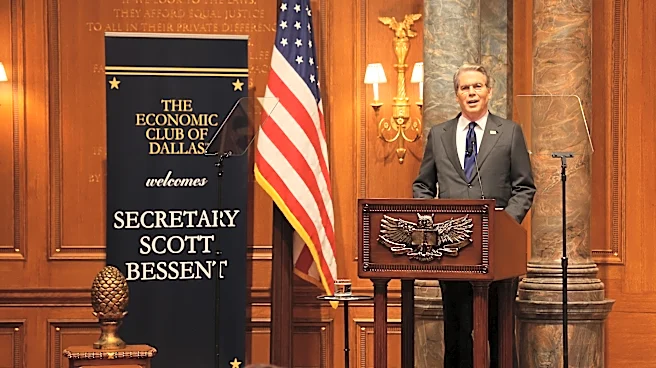
Treasury Secretary Scott Bessent and Secretary of Education Linda McMahon have clarified the official naming convention for the federal tax credit designed to support K-12 education. The U.S. Department of the Treasury will officially refer to it as the Federal
Scholarship Tax Credit (FSTC), or by its Internal Revenue Code designation, IRC §25F. This clarification aims to standardize terminology, as the credit has previously been known by various names, including the Federal Tax Credit for Scholarships (FTCS) and the Education Freedom Tax Credit (EFTC). Secretary McMahon, focusing on education, views the credit as expanding educational freedom and may use EFTC in that context. The FSTC, signed into law on July 4, 2025, as part of the One Big Beautiful Bill Act, is described as a simple tax mechanism that benefits K-12 students and is not a voucher program, despite attempts by opponents to label it as such.
Why It's Important?
The standardization of the name for the Federal Scholarship Tax Credit is important for clarity and consistency in public discourse and regulatory documents. By officially designating it as the FSTC, the Treasury aims to reduce confusion among stakeholders, including parents, educators, and potential donors. This clarity can facilitate better understanding and utilization of the tax credit, which is designed to incentivize private donations to nonprofits that provide K-12 scholarships. The distinction from a 'voucher' is also crucial, as the term carries significant political baggage and is often associated with government-funded and controlled public schools. By framing it as a tax credit that encourages voluntary private giving, the initiative seeks to broaden educational opportunities without directly involving government in the funding of individual students' education choices, thereby promoting educational freedom.
What's Next?
With the official naming convention established, organizations like EdChoice, which advocates for school choice, will adopt the FSTC terminology in their communications. This standardization is expected to streamline discussions and policy implementation related to the tax credit. The focus will now shift towards promoting awareness of the FSTC and encouraging its use to expand educational access for K-12 students. The long-term impact will depend on the extent to which the tax credit successfully incentivizes private donations and whether these donations effectively translate into increased educational opportunities and improved outcomes for students. Ongoing debates about the nature and impact of such tax credits in the broader education landscape are likely to continue.
Beyond the Headlines
The debate over the naming of the Federal Scholarship Tax Credit, and its distinction from a 'voucher,' highlights deeper ideological divisions in U.S. education policy. Proponents of the FSTC view it as a mechanism to empower parents and expand educational choices, particularly for students in underserved communities, by leveraging private philanthropy. They see it as a tool for 'educational freedom.' Conversely, opponents often view such initiatives as undermining public education systems and potentially diverting resources or attention from them. The careful choice of terminology reflects an attempt to frame the policy in a way that aligns with its intended purpose of encouraging private support for education, rather than being perceived as a direct government funding program. This linguistic precision underscores the ongoing cultural and political battles over the future direction of education in the United States.