



What's Happening?
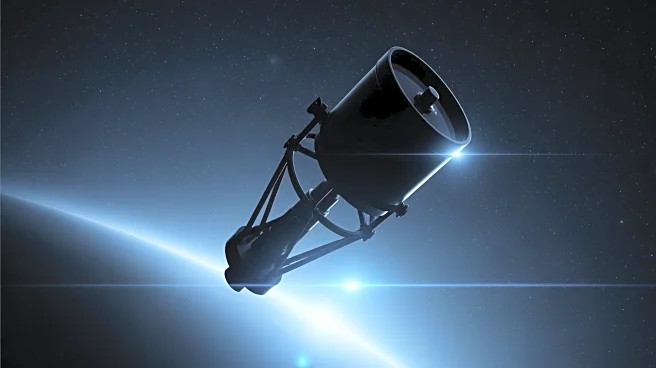
A NASA-led study has raised concerns about the impact of satellite reflections on images captured by space telescopes. The study, published in Nature, indicates that the increasing number of satellites orbiting Earth could ruin over 95% of images taken
by some space telescopes in the next decade. This issue arises from the reflected light, known as satellite trails, which has already been observed in images from NASA's Hubble Space Telescope. The problem is expected to worsen as more satellites are launched. Currently, there are over 10,000 active satellites, with SpaceX owning more than 7,800 Starlink satellites. The International Telecommunication Union (ITU) has noted that thousands more satellites are planned for launch. The study predicts that telescopes like NASA's SPHEREx, the European Space Agency's ARRAKIHS, and China's Xuntian could deliver images filled with streaks, significantly impacting astronomical observations.
Why It's Important?
The proliferation of satellites poses a significant challenge to astronomical research and space exploration. The contamination of telescope images with satellite trails could hinder the ability of scientists to capture critical astronomical events, such as supernovae or distant galaxies. This could lead to a loss of valuable scientific data and impede advancements in our understanding of the universe. The American Astronomical Society has expressed concerns about potential collisions and the generation of space debris, which could further threaten the sustainability of space activities. The study underscores the need for international cooperation and stricter regulations to manage the growing number of satellites and mitigate their impact on space-based observations.
What's Next?
Efforts to address the issue include SpaceX's initiatives to reduce the light cast by its satellites, such as testing darker coatings and adding visors. However, the effectiveness of these measures remains to be seen. The ITU has called for stricter international rules to manage satellite networks and ensure the long-term viability of orbital resources. Collaborative efforts between federal agencies, the satellite industry, and the scientific community are essential to develop solutions that minimize the impact of satellite constellations on astronomy. Ongoing discussions and policy developments will be crucial in balancing the benefits of satellite technology with the preservation of space for scientific exploration.