







What's Happening?
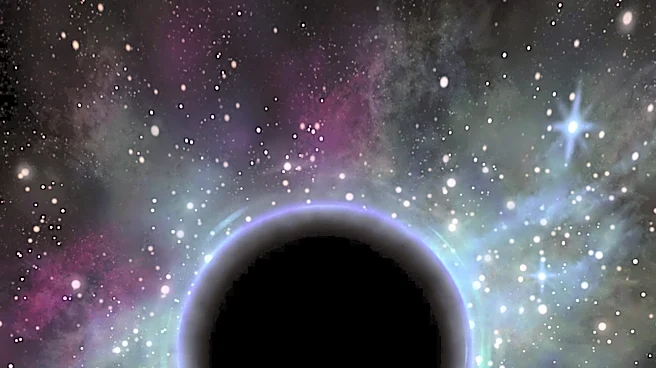
Physicists have detected a signal emanating from the event horizon of a black hole for the first time. This discovery was made during the observation of the gravitational-wave event GW250114, recognized as the most powerful black-hole collision ever observed.
The event was detected by the LIGO observatory in the United States. The collision involved two black holes orbiting each other in a spiral pattern until they merged, forming a single, more massive black hole. The signal, a direct wave, was isolated using new analytical techniques developed by Neil Lu and his colleagues at the Australian National University. This wave provides information about the black hole's rotation and the strength of gravity near its event horizon, offering a novel approach to testing Albert Einstein's general theory of relativity.
Why It's Important?
The detection of a signal from the event horizon of a black hole is significant as it provides a new method to test the general theory of relativity. This theory, which describes gravity and spacetime on a macroscopic scale, has yet to be fully reconciled with quantum mechanics, which explains matter and energy at the smallest scales. The ability to measure the rotation rate and gravity strength near a black hole's event horizon could lead to refinements in existing physical models. This discovery also highlights the potential of gravitational waves as a source of data for understanding the fundamental forces of the universe.
What's Next?
Future research will likely focus on further isolating and analyzing signals from black holes to test the limits of general relativity. Scientists may also explore the implications of these findings for quantum mechanics and the potential need for new theories that bridge the gap between these two fundamental areas of physics. Continued advancements in gravitational wave detection technology will be crucial for these efforts.