
What's Happening?
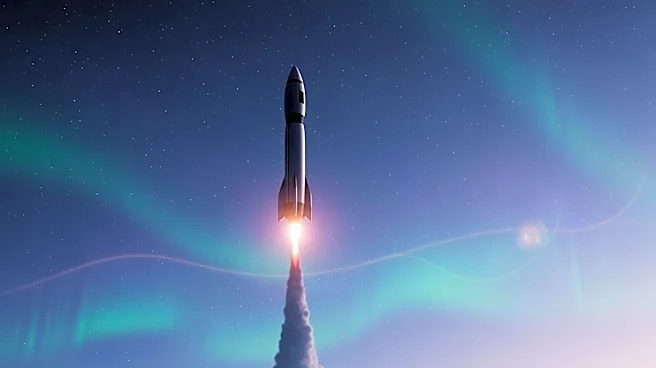
The European Space Agency (ESA) and the Chinese Academy of Sciences have successfully launched the SMILE (Solar wind Magnetosphere Ionosphere Link Explorer) mission into orbit. The launch took place on May
18, 2026, from Europe's Spaceport in Kourou, French Guiana, using a Vega C rocket. The mission aims to study the effects of the solar wind on Earth's magnetosphere, which is crucial for understanding solar and geomagnetic storms. The SMILE spacecraft, equipped with four scientific instruments, will provide valuable data on space weather phenomena. The mission is a collaborative effort, with ESA providing the payload module and one of the instruments, while the Chinese Academy of Sciences is responsible for the satellite platform and three other instruments. The mission is expected to last three years, with the first scientific data anticipated three months post-launch.
Why It's Important?
The successful launch of the SMILE mission marks a significant advancement in international collaboration in space exploration, particularly between Europe and China. By studying the solar wind's impact on Earth's magnetosphere, the mission will enhance our understanding of space weather, which can have profound effects on satellite operations, communication systems, and power grids on Earth. This research is vital for developing strategies to mitigate the adverse effects of solar storms, which can disrupt technological infrastructure. The mission also represents a step forward in the use of advanced space technology to address global scientific challenges, potentially benefiting industries reliant on satellite technology and communication networks.
What's Next?
Following the successful launch, the SMILE spacecraft will undergo a series of engine burns over the next 25 days to adjust its orbit. This will position the satellite in a highly elliptical orbit, allowing it to gather comprehensive data from different altitudes. The mission team will conduct various checkouts to ensure the instruments are functioning correctly. The first scientific images are expected to be received approximately three months after launch, marking the beginning of the mission's scientific operations. The data collected will be analyzed to improve predictive models of space weather, which could lead to better preparedness for solar storm events.