








What's Happening?
Modern warfare technology is evolving at an unprecedented pace, creating an 'obsolescence trap' for military procurement. Traditional acquisition models, which involve lengthy development cycles, struggle to keep up with the rapid advancements in offensive
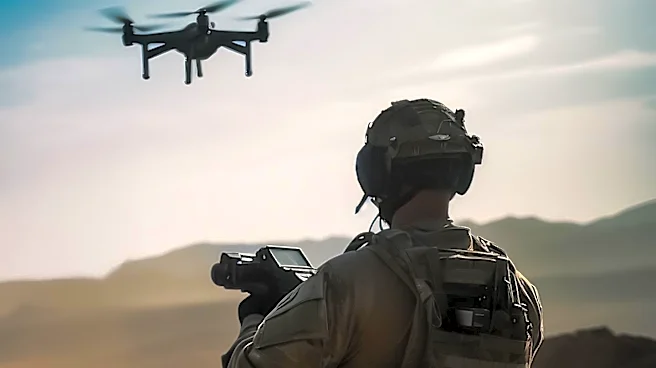
and defensive systems. For instance, the Bayraktar TB2 drone, once a formidable weapon for Ukraine, became largely outdated by mid-2023 due to Russia's improved air defenses and the proliferation of smaller, cheaper FPV drones. Its manufacturer, Baykar, has since reconfigured it into a 'drone mother ship' capable of carrying 16 one-way UAVs and serving as a communications relay. The Pentagon's current programs average over 12 years from start to delivery, a timeframe deemed an 'eternity' in today's fast-changing combat environment. This challenge is leading to a push for modular, adaptable platforms and 'capability-centric, software-first procurement' with open architectures and standardized interfaces.
Why It's Important?
This rapid technological evolution and the 'obsolescence trap' have significant implications for U.S. military readiness and defense spending. The U.S. military, with its substantial investment in long-term, high-cost weapons programs, risks deploying systems that are outdated upon arrival. This necessitates a fundamental shift in procurement strategies to prioritize adaptability, modularity, and faster innovation cycles. Failure to adapt could lead to a strategic disadvantage against adversaries who can rapidly deploy new technologies. The U.S. defense industry, a major economic driver, will need to embrace these changes, potentially shifting from large, monolithic projects to more agile, software-driven development. This also impacts international alliances, as interoperability between U.S. and allied systems becomes even more critical when technologies are constantly changing.
What's Next?
The U.S. military is actively seeking solutions, such as the Air Force's Collaborative Combat Aircraft program, which aims to field autonomous 'wingman' drones using a government-owned software architecture to allow integration of competing suppliers' software. Congress has also mandated a Modular Open Systems Approach (MOSA) for major weapons programs since 2019, though implementation has been inconsistent. Future efforts will focus on enforcing MOSA, streamlining procurement processes, and fostering a culture of continuous innovation within the defense sector. This includes addressing issues like repair rights and digital file ownership to ensure that militaries can adapt and upgrade equipment without being solely dependent on original manufacturers. The goal is to move towards 'capability-centric' procurement that prioritizes flexible, integrated systems over platform-specific solutions.
Beyond the Headlines
The 'obsolescence trap' extends beyond hardware to the very nature of military planning and strategy. It challenges the traditional concept of a 'generational' leap in military technology, suggesting instead a continuous, iterative process of development and deployment. This rapid pace also raises ethical questions about the speed at which new weapons, particularly autonomous ones, are introduced into warfare, potentially outpacing the development of international norms and regulations. The emphasis on software and modularity could democratize defense technology to some extent, allowing smaller, more agile companies to contribute, but also creating new cybersecurity vulnerabilities. Ultimately, the future of warfare will not just be about who has the most advanced weapons, but who can adapt and innovate the fastest.