






What's Happening?
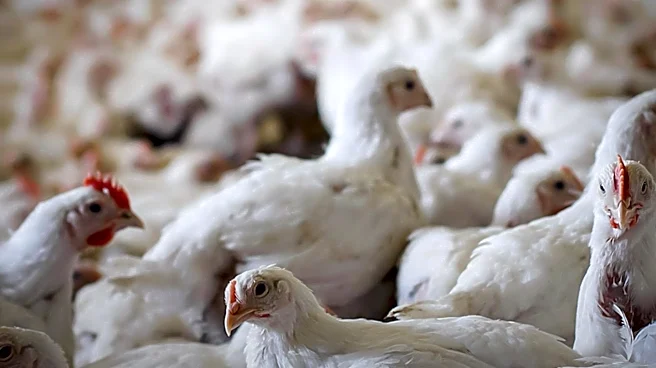
The broiler chicken, a product of modern industrial agriculture, is being highlighted as a significant geological tracer of the proposed Anthropocene epoch. In 1925, an average chicken for slaughter was 112 days old, weighed 2.5 pounds, and consumed 4.7
pounds of feed per pound of liveweight. Today, an industrially raised chicken lives for 47 days, reaches 6.57 pounds, and requires only 1.69 pounds of feed per pound of chicken. These birds are processed by the billions annually, making poultry the world's most consumed meat. The sheer abundance and distinct physical characteristics of these chickens mean their fossilized remains will be an unmistakable signature in Earth's crust, indicating human dominance. This concept aligns with the broader idea of the Anthropocene, a new geological epoch defined by human influence on Earth's systems, with a proposed start date around the mid-twentieth century, marked by various human-induced changes including plastic pollution, synthetic fertilizers, and nuclear bomb test residues.
Why It's Important?
The designation of the broiler chicken as a geological marker underscores the profound and lasting impact of human activity on the planet. This shift from natural evolutionary processes to human-directed biological engineering illustrates how deeply human consumption patterns and agricultural practices have altered the biosphere. The rapid growth and immense scale of broiler chicken production reflect the 'Great Acceleration' post-1950, characterized by surges in human population, economic growth, and resource consumption. This has led to a situation where the combined weight of humans and domesticated mammals vastly exceeds that of all wild mammals, fundamentally altering global biodiversity. The fossilized remains of these chickens will serve as an indelible record for future geologists, signaling a decisive turning point in Earth's evolutionary and geological history, driven by human appetites and technological capabilities.
What's Next?
While the Subcommission on Quaternary Stratigraphy voted against formally adopting the Anthropocene as a new epoch in 2024, the scientific and public discourse around the term continues to grow. The ongoing debate among geologists is expected to eventually recognize the Anthropocene, given the increasing evidence of human-induced planetary changes. Future research will likely continue to identify and analyze other 'technofossils' and geological markers that signify humanity's impact. The concept will continue to serve as a paradigm for understanding humanity's place in Earth history and its influence on global biodiversity. This ongoing recognition will likely influence policy discussions on environmental conservation, sustainable agriculture, and resource management, as the long-term geological consequences of current human activities become more widely acknowledged.
Beyond the Headlines
The broiler chicken's role as a geological marker extends beyond mere scientific classification; it highlights ethical and cultural dimensions of human interaction with the natural world. The transformation of a species into a hyper-efficient food production unit raises questions about animal welfare, the ethics of genetic modification for consumption, and the sustainability of industrial agriculture. This development also points to a fundamental inversion of humanity's ecological predicament, from scarcity to surplus, which has profound implications for global resource distribution and environmental justice. The 'stuff' produced by human civilization, including the bones of billions of chickens, now outweighs all living biomass on the planet, signifying a long-term shift in Earth's material composition. This deep impact challenges humanity to reconsider its relationship with the planet and its responsibility as a dominant geological force.