





What's Happening?
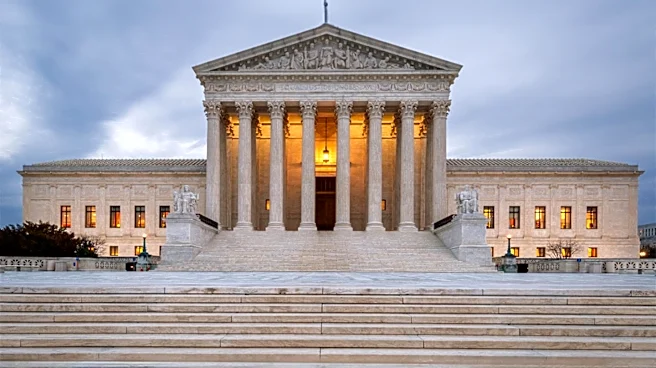
The Constitutional Accountability Center (CAC) has filed an amicus brief with the Supreme Court in the case of Montoya Palacios v. Liggins. The case centers on whether the Equal Access to Justice Act (EAJA), which authorizes the award of legal fees to a prevailing
party in 'any civil action' against the United States, applies to habeas actions seeking relief from immigration detention. Kevin Isaac Montoya Palacios, who was granted withholding of removal in 2016, was detained by ICE in 2025 without claims of being a threat or flight risk. After a district court ordered his release, it denied his request for legal fees, ruling that habeas actions are not 'civil actions' under the EAJA in the Fourth Circuit. The Court of Appeals affirmed this decision, leading to the Supreme Court's agreement to hear the case. The CAC's brief argues that the EAJA's waiver of sovereign immunity should be broadly interpreted to include habeas actions, consistent with congressional intent.
Why It's Important?
This Supreme Court case has significant implications for individuals challenging their detention, particularly in immigration cases, and for the interpretation of federal statutes concerning legal fees. If the Supreme Court rules that habeas actions are not covered by the EAJA, it could make it more difficult and costly for individuals to challenge unlawful detention, potentially limiting access to justice for those without significant financial resources. Conversely, a ruling in favor of Montoya Palacios would affirm that individuals who successfully challenge government actions, including immigration detention, can recover their legal expenses, thereby incentivizing legal challenges against potentially unlawful government conduct. The case also touches on fundamental principles of statutory interpretation and the separation of powers, as the CAC argues that courts should respect Congress's clear intent in waiving sovereign immunity through the EAJA, rather than narrowly construing the statute.
What's Next?
The Supreme Court will hear arguments in Montoya Palacios v. Liggins, with the CAC's amicus brief contributing to the legal discourse. The Court's decision will clarify the scope of the Equal Access to Justice Act and its applicability to habeas actions, particularly those related to immigration detention. A ruling is expected to have a direct impact on how legal fees are awarded in such cases across the country. Depending on the outcome, Congress might consider legislative action to further clarify the EAJA's provisions if the Court's interpretation deviates significantly from what some perceive as congressional intent. The decision will also influence legal strategies for individuals seeking to challenge government detention and for organizations providing legal aid in such matters.
Beyond the Headlines
Beyond the immediate legal question of fee awards, this case highlights the broader issue of due process for undocumented immigrants and the power of the executive branch in immigration enforcement. The detention of Kevin Isaac Montoya Palacios, despite a prior grant of withholding of removal and no stated threat or flight risk, underscores concerns about the potential for arbitrary detention. The ability to recover legal fees under the EAJA is crucial for ensuring that individuals, regardless of their financial status, can effectively challenge government actions that may infringe upon their rights. This case also implicitly addresses the role of the judiciary in overseeing executive power, particularly in sensitive areas like immigration. The Supreme Court's interpretation of 'civil action' in this context could reinforce or weaken the checks and balances designed to protect individual liberties against potential government overreach.