







What's Happening?
A partial dinosaur skull, acquired by London's Natural History Museum in 1924, has been identified as a new species named Invictibellatrix amberina. This discovery marks the first megaraptoran found in Europe. The fossil, a braincase fragment from the back
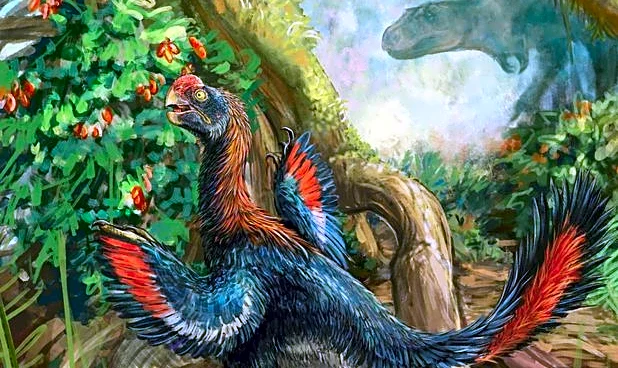
of the skull, was never formally described despite a physical cast of its brain cavity being made shortly after its acquisition. Dr. Cassius Morrison of University College London (UCL) Earth Sciences, the lead author of the study, noted the mystery surrounding why the fossil was overlooked for so long. Researchers utilized CT scans to create 3D models of the bone and brain space, comparing them to other meat-eating dinosaurs. The analysis placed Invictibellatrix among the megaraptorans, a group of agile, two-legged carnivores related to tyrannosaurs. This species, estimated to be about 13 feet (4 meters) long and weighing between 440 to 660 pounds (200 to 300 kilograms), likely had feathers and would have preyed on small dinosaurs, lizards, and mammals.
Why It's Important?
The identification of Invictibellatrix amberina significantly expands the understanding of dinosaur distribution and evolution, particularly for megaraptorans. Its presence in Europe challenges previous assumptions about the geographic spread of these predators, suggesting an evolutionary path where Asian megaraptoran populations dispersed into Europe approximately 130 million years ago. This finding indicates that megaraptorans reached Gondwana via Europe, rather than through more southerly island-hopping routes. The study highlights the immense value of historical museum collections, demonstrating that significant scientific discoveries can still emerge from long-held, undescribed specimens. It also provides crucial neurocranial data that helps clarify the phylogenetic relationships of theropods, contributing to a more accurate picture of prehistoric ecosystems and the complex interactions between ancient species.
What's Next?
The discovery of Invictibellatrix is expected to spur further research into European fossil records, particularly on the Isle of Wight, which continues to yield new dinosaur species. Paleontologists will likely re-examine other undescribed specimens in museum collections, applying advanced imaging techniques like CT scans to uncover more hidden species. This could lead to a more comprehensive understanding of megaraptoran evolution and their dispersal patterns across ancient continents. The ongoing debates about the hunting strategies and ecological roles of these carnivores may also be informed by this new data. Future studies might focus on identifying additional megaraptoran fossils in Europe and Asia to trace their migratory routes and evolutionary divergences more precisely, potentially revealing more about the regional extinction events that led to their absence in Late Cretaceous Laurasia.
Beyond the Headlines
This discovery underscores the enduring importance of paleontological research and the often-overlooked potential within existing museum archives. The fact that a significant new species remained unidentified for nearly a century in a prominent institution like the Natural History Museum highlights the vastness of undiscovered knowledge even within well-studied collections. It also serves as a reminder of the continuous evolution of scientific methods, where new technologies like CT scanning can unlock secrets from old specimens. Ethically, it emphasizes the responsibility of museums to continually re-evaluate and analyze their collections with modern tools and perspectives. Culturally, it enriches our understanding of Earth's ancient past, painting a more detailed picture of the diverse life forms that once roamed the planet and how their ecosystems functioned.