



What's Happening?
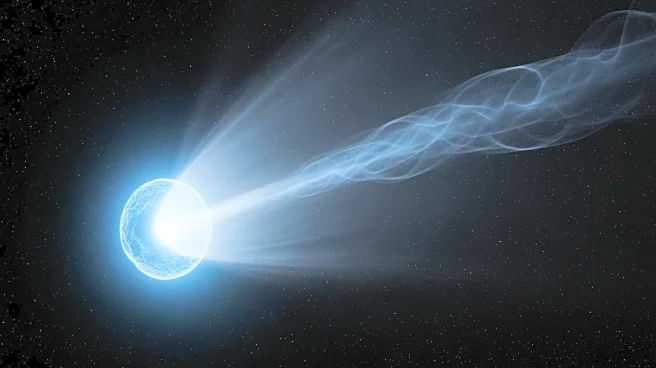
Astronomers have captured X-ray images of the interstellar comet 3I/ATLAS, marking the first time such observations have been made for an interstellar object. The European Space Agency's XMM-Newton observatory and the X-Ray Imaging and Spectroscopy Mission
(XRISM) led by JAXA, in partnership with NASA and ESA, have provided these unprecedented views. The X-ray emissions result from interactions between the solar wind and the comet's gas cloud, allowing scientists to detect gases like hydrogen and nitrogen that are difficult to observe with other instruments. The XRISM telescope observed the comet for 17 hours, revealing X-ray emissions extending about 250,000 miles from the comet's nucleus.
Why It's Important?
These X-ray observations are significant as they offer a new method to study interstellar objects, providing insights into their composition and the interactions with solar wind. Understanding the gases present in comets like 3I/ATLAS can help scientists learn more about the building blocks of the universe and the processes that occur when interstellar objects enter our solar system. This research could lead to a better understanding of the materials that make up comets and their potential impact on planetary systems.
What's Next?
Further observations of 3I/ATLAS are planned to continue studying its composition and behavior as it travels through the solar system. These studies will help refine models of interstellar comet interactions and contribute to the broader understanding of cosmic phenomena. The data collected will be analyzed to explore the potential for discovering new elements or compounds in interstellar comets, enhancing our knowledge of the universe's chemical diversity.